





If you have read through the Psalms, you have probably noticed a word sitting at the end of a verse with no explanation attached. Selah. Most Bibles print it without defining it, and most readers move past it without knowing what to do with it. That confusion is understandable. Biblical scholars have wrestled with this word for centuries.
This article explores what Selah means, why it appears so often in the Psalms, and what it might offer you in your own reading of Scripture today. The answer is not entirely settled, but the clues we have are worth sitting with.
Why Most Bibles Leave Selah Untranslated
Selah is left untranslated in most English versions of the Bible because no one knows with certainty what it means. The ESV, KJV, NIV, and NASB all carry the original Hebrew word directly into the English text. One exception is the New Living Translation, which renders Selah as "Interlude," reflecting the most widely held scholarly interpretation.
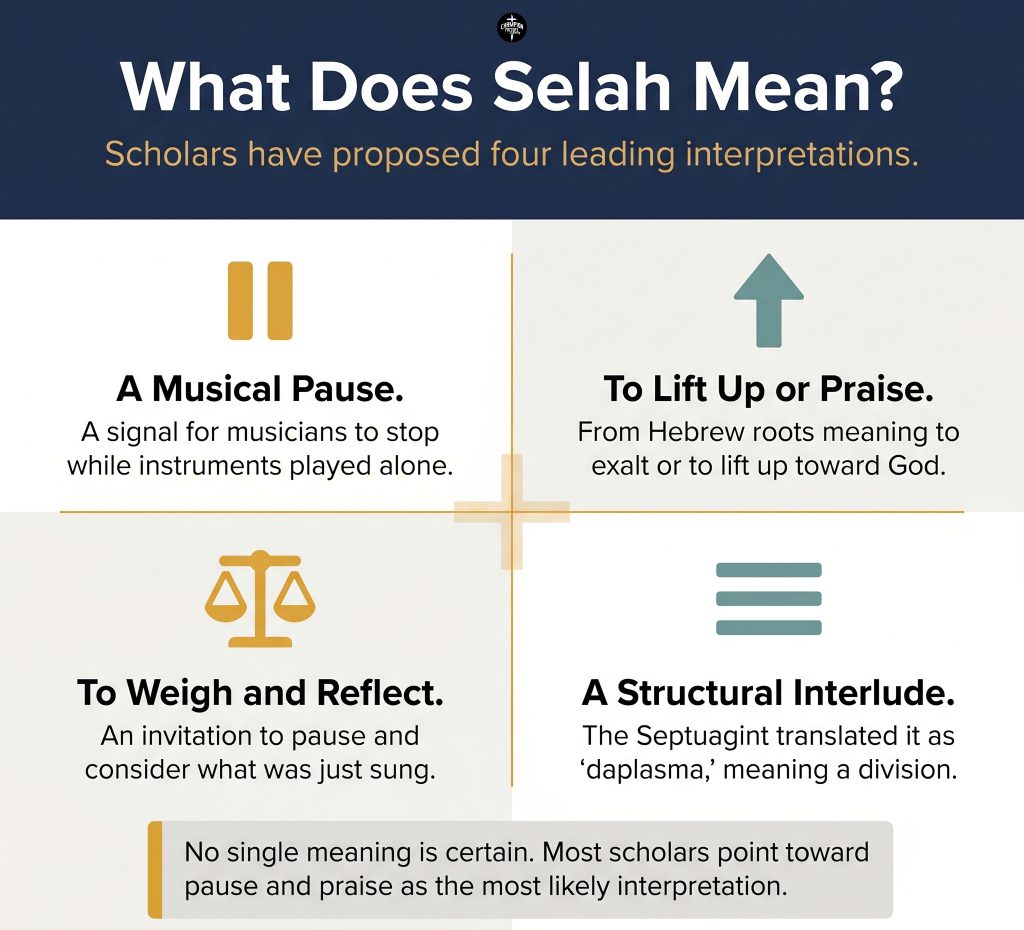
Biblical scholar Peter Craigie, writing in his commentary on the Psalms, stated plainly that "the etymology of the term and its precise significance remain uncertain." This is not a translation the scholars overlooked. It is a word whose original meaning has been debated since antiquity. Even the ancient Greek translation of the Old Testament, known as the Septuagint, rendered Selah as "daplasma," meaning a division. Translators across every generation have acknowledged that the word resists a clean answer.
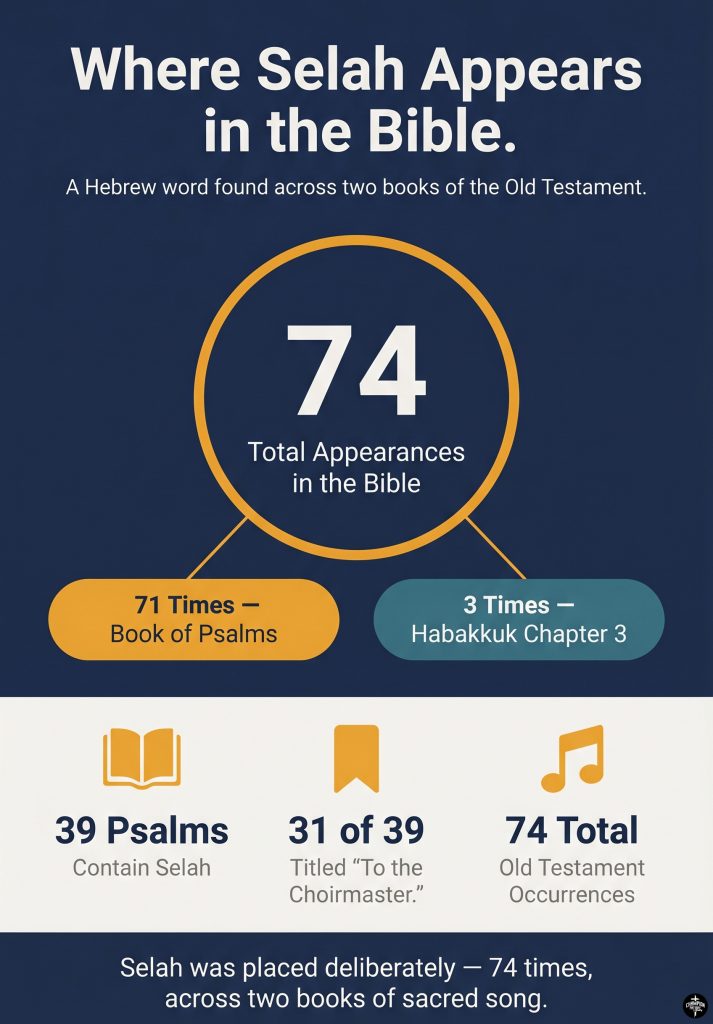
That uncertainty does not make the word unimportant. It appears 74 times across two books of the Bible, 71 in the Psalms alone, spread across 39 different psalms. A word placed that often was placed there deliberately.
What the Psalms Were in Ancient Israel
The Psalms were not only poetry. They were songs sung in communal worship at the temple in Jerusalem. The Hebrew title for the book, tehilim, means "praises," and it reflects their primary purpose: directing praise toward God. Understanding the Psalms as a living worship tradition helps explain why a musical term like Selah would appear inside them.
Thirty-one of the thirty-nine Psalms that contain Selah carry the title "to the choirmaster" or a similar musical dedication. That pattern points clearly toward a musical function. The Psalms were performed, not only read. They were accompanied by instruments, led by worship directors, and sung by the gathered people of Israel.
"Evangelism often begins with listening. When we introduce people to the Psalms, we are showing them that God's Word has been making room for honest prayer for thousands of years." — Art Montgomery, Global Evangelism Strategy Architect, Champion Factory Ministry
Selah is not a literary footnote. It is a word embedded in a song, at a specific moment, for a specific purpose.
What Selah Most Likely Means
Most scholars believe Selah was a musical term that signaled a pause, an interlude, or a shift in how a Psalm was performed. It may have prompted musicians to play while singers rested, or called the congregation to a moment of elevated response. Some Hebrew roots associated with Selah point toward "to lift up" or "to praise." No single theory is certain, but pause and praise together capture what most evidence points toward.
The Amplified Bible takes a practical approach by adding "pause and calmly think about that" wherever Selah appears. That rendering may not be linguistically precise, but it reflects the spirit most scholars describe. Whatever its original musical instruction, the intent was consistent: stop here, hold this, let it matter before moving on.
Selah in Context: What Psalm 3 Shows Us
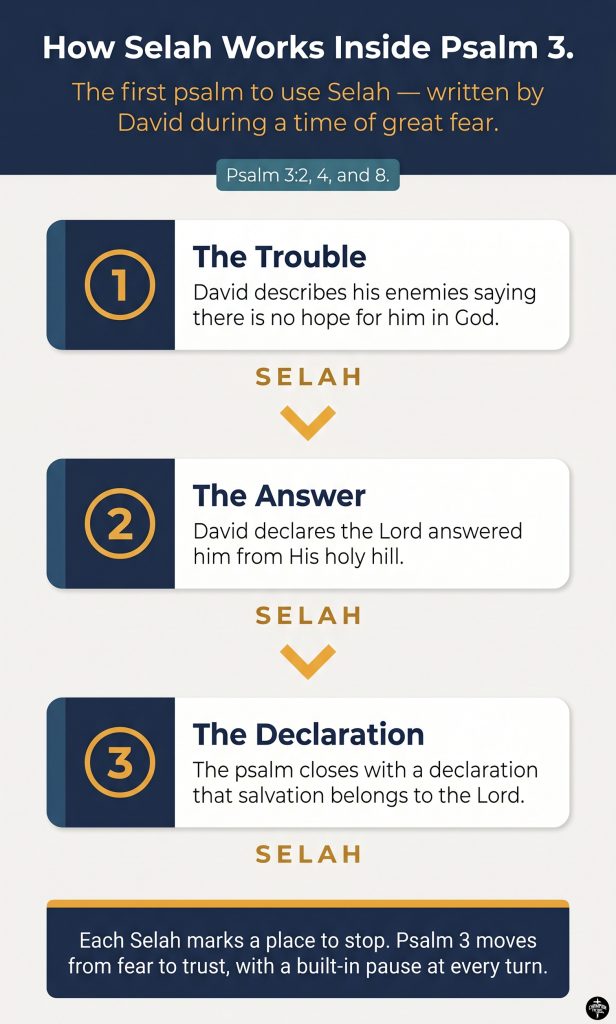
Psalm 3 is the first psalm in the Bible to use Selah, and it appears three times, at verses 2, 4, and 8. What makes this example worth examining is the setting. Psalm 3 is a lament, written by David when he was fleeing from his son Absalom. Selah does not appear only in songs of celebration. It appears in the middle of fear and loss.
Each of the three Selah markers falls after a turning point in the psalm.
- After verse 2, David has just described his enemies declaring there is no hope for him in God.
- After verse 4, David declares that the Lord answered him from His holy hill.
- After verse 8, the psalm closes with a declaration that salvation belongs to the Lord.
Each Selah marks a moment worth pausing on: the trouble, the answer, the declaration. The placement is not random. It shows a psalm moving through grief toward trust, with structured pauses that follow the psalm's movement.
"The Psalms have been a steady companion for people we walk alongside who are carrying a great deal. Reading them slowly, letting each verse land before moving to the next, that is where something often shifts." — Todd Medina, President and Founder, Champion Factory Ministry
Psalm 46, where Selah also appears three times, closes with one of Scripture's best-known invitations: "Be still, and know that I am God" (Psalm 46:10, NIV). That verse does not contain the word Selah, but it captures the same movement: stop, receive, let this settle.
Selah in Habakkuk: Not Only a Psalms Word
Selah appears three times in Habakkuk 3, at verses 3, 9, and 13. Habakkuk is a prophet writing during a season of national crisis. His third chapter is a prayer composed in song form, and each Selah marks a moment of weight and turning in the text.
The chapter closes with one of the most honest declarations of trust in all of Scripture: "Though the fig tree does not bud and there are no grapes on the vines...yet I will rejoice in the Lord, I will be joyful in God my Savior" (Habakkuk 3:17-18, NIV). Selah appears before that declaration. The pause makes room for what follows.
How to Let Selah Shape How You Read Scripture
You do not need to resolve the scholarly debate to use Selah well. When you encounter the word in the Psalms or in Habakkuk, treat it as a cue to stop. Reread the verse before it. Hold the thought for a moment before moving on. The placement of Selah has always been an invitation, not a puzzle.
A few simple ways to engage with Selah in your reading:
- Pause when you see it.
- Reread the verse or passage just before it.
- Sit with whatever came before the pause: a cry, a declaration, a truth about God.
- Bring it briefly to prayer before continuing.
The Psalms were written for real people in real circumstances. David wrote about betrayal, fear, and exhaustion. Habakkuk wrote about watching his world fall apart. Selah appears in those places. Scripture has always acknowledged the full range of human experience, and the presence of lament psalms confirms that.
If you are walking through a hard season and the Psalms have become your companion, you are not alone. If you want to explore Scripture alongside others, our Nourish discipleship program offers guided Bible engagement in community.
Selah Is an Invitation, Not a Gap in Your Bible
Selah is not a translation error. It is not a mystery that makes Scripture less trustworthy. It is an ancient word whose original technical meaning has been lost to time, but whose function is still visible in where it sits and what surrounds it.
It appears at moments of grief and moments of praise. It marks truths worth absorbing and declarations worth carrying. Scholars hold different views on what it meant to the musicians who performed the Psalms. But the experience of encountering it has not changed in three thousand years.
Stop. Weigh this. Lift your eyes.
That is still enough.
FAQ
Does Selah Appear Only in the Psalms?
No. Selah appears 71 times in the Psalms and 3 times in Habakkuk chapter 3, for a total of 74 occurrences in the Bible.
Why Do Most Bible Translations Not Define Selah?
Most translations leave Selah untranslated because its exact meaning is genuinely uncertain. The New Living Translation is a notable exception, using the word "Interlude" in its place.
Does Selah Only Appear in Happy or Celebratory Psalms?
No. Selah appears in lament psalms and crisis psalms as well, including Psalm 3, which David wrote while fleeing from his son Absalom.
How Should I Respond When I See Selah in the Bible?
Pause. Reread the verse just before it. Let the thought settle before you move forward. Whether the passage is about praise, pain, or trust, Selah is an invitation to hold it for a moment.