





News coverage shows the rescue and the reunion. It rarely shows the weeks between. Typically, a rescued animal goes to a shelter, gets a microchip scan, and waits while its owner searches. Then it goes home, is adopted, or moves to another shelter.
Champion Factory Ministry believes a rescue is the first act of care, not the last. Faithful care stays with the work through treatment, the search for an animal's family, and a safe home. That matches the ministry's approach to people, which moves from immediate support to ongoing care and long-term restoration. Here is what to expect at each stage and how you can help well.
Where Do Rescued Animals Go First?
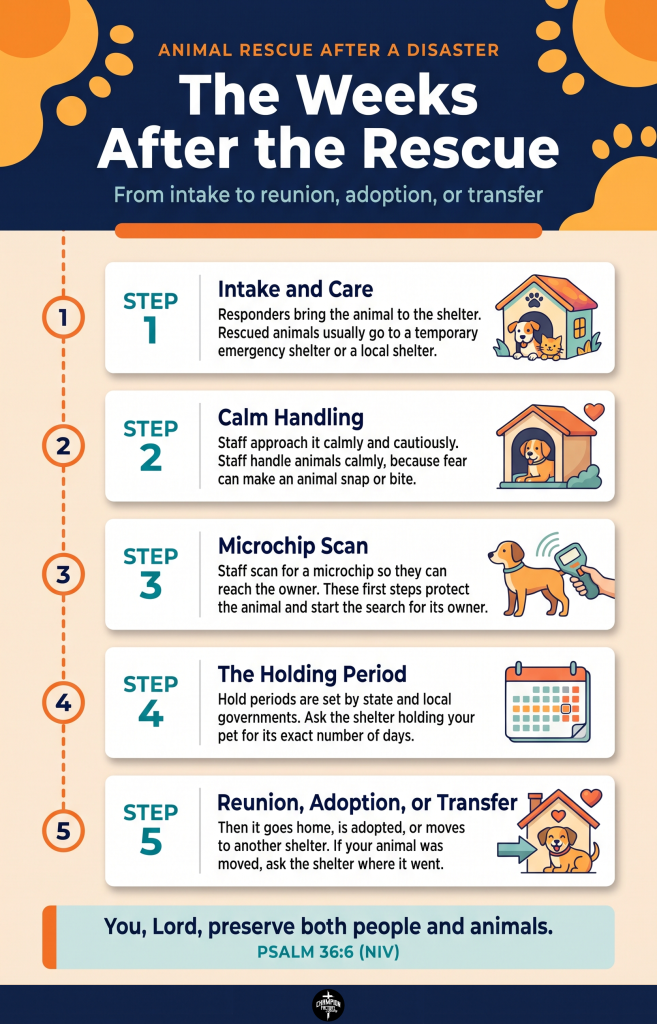
Rescued animals usually go to a temporary emergency shelter or a local shelter. Staff scan them for a microchip and handle them calmly, because fear can make an animal snap or bite. These first steps protect the animal and start the search for its owner.
CDC interim guidance for disaster shelters advises scanning arriving animals for microchips and approaching rescued animals calmly but cautiously. It is advisory guidance, and local practice varies.
The First Three Steps at Intake
- Responders bring the animal to the shelter.
- Staff approach it calmly and cautiously.
- Staff scan for a microchip so they can reach the owner.
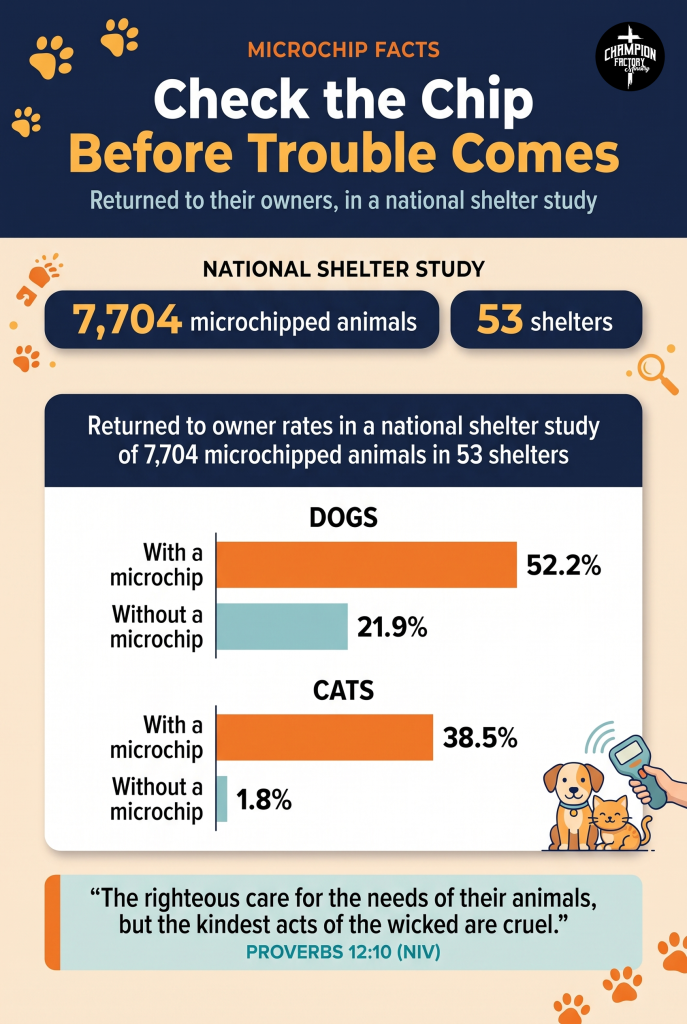
In a national shelter study of 7,704 microchipped animals in 53 shelters, microchipped stray dogs were returned to their owners 52.2 percent of the time, against 21.9 percent for dogs without microchips. That was a general shelter study, not a disaster study.
Check the Chip Before Trouble Comes
Ask your veterinarian to scan your pet's chip and confirm the registry has your current phone number. Add a collar tag with your number so anyone who finds your pet can reach you.
Proverbs 12:10 (NIV) says, "The righteous care for the needs of their animals, but the kindest acts of the wicked are cruel." Care for an animal's needs starts at intake and often continues long after.
How Do Owners Find Rescued Pets, and How Long Do Shelters Wait?
If your pet is missing after a disaster, start by contacting the shelter or animal control office that serves the area where you lost it. Ask whether it is holding animals from the disaster and for how many days. Hold periods are set locally, so get the number from the shelter itself.
State and local governments typically set a minimum holding time for animals brought to a community shelter. After that time passes, unclaimed animals can be adopted. No single national number exists.
ASPCA Director of Disaster Response Susan Anderson says companion animals at emergency shelters "are cared for until their owners can retrieve them." Reunions do not always come quickly. NPR reports that some owners did not reunite with their animals for years after Hurricane Katrina.
Animals Are Usually Held Before Adoption
For example, an owner who evacuated may return to find a pet missing and worry that a shelter will adopt it out within days. Animals are typically held for a minimum time first. That time depends on local rules, so ask early and ask again.
Waiting Is Hard, and Grief Is Real
Losing a pet is a real loss. If a pet is hurt, call a veterinarian.
"Grief over an animal is not weakness. If the weight stays heavy, tell a pastor or a counselor, and do not carry it alone." Todd Medina, President & Founder
Prayer and encouragement go alongside professional care. They do not replace it.
What Happens to Animals No One Claims?
Psalm 36:6 (NIV) says, "You, Lord, preserve both people and animals." That is why finding each animal a safe place matters. The ASPCA says animals that are surrendered or cannot be reunited are made available for adoption locally or relocated to partner shelters. Some outcomes are hard, and no one can promise every animal finds a home.
After Hurricane Helene, the ASPCA ran a temporary shelter in Conover, North Carolina. After reunifications, 126 animals were placed through partner shelters. The dozen animals still without homes were moved to the ASPCA Cruelty Recovery Center in Ohio. The page does not say how many animals went home.
Staying With the Work in Tijuana
Champion Factory Ministry does not run animal rescue in disaster zones. Its animal work is street outreach and veterinary care in Tijuana and San Diego. Teams working in the Tijuana area saw thousands of dogs on the streets, hungry, injured, and without care. Bringing food and water on their routes grew into a structured outreach across Tijuana and San Diego.
The ministry reports more than 3,500 dogs fed and more than 20,000 bags of dog food distributed. It also reports 10 dogs hospitalized, treated, and given life-saving operations, and multiple cats hospitalized, operated on, and restored to health. The ministry coordinated veterinary care for the most critical animals, and some animals were lost despite treatment. Read the full outreach story.
"Children in poverty and animals on the street did not choose their circumstances. Both deserve steady care." Todd Medina, President & Founder
Keep Going Without a Promised Result
Galatians 6:9 (NIV) says, "Let us not become weary in doing good, for at the proper time we will reap a harvest if we do not give up." The verse calls believers to keep doing good. It does not promise a particular result.
Why Are Pets Part of Disaster Plans Today?
In Hurricane Katrina, the evacuation message was to leave pets behind. Congress responded with the PETS Act, signed on October 6, 2006. It requires state and local emergency plans to address the needs of individuals with household pets and service animals after a major disaster or emergency.
The PETS Act amended Section 403 of the Stafford Act. FEMA's 2007 policy on pet costs says that section authorizes FEMA to provide rescue, care, shelter, and essential needs to households with pets and service animals, and to the animals themselves. State and local governments are the eligible applicants. That policy was in effect from 2007 through 2015. FEMA's current evacuation and sheltering fact sheet lists transport of household pets and service animals among eligible evacuation costs.
Owners Who Left Pets Were Not Careless
Animal rescue manager Randy Covey spent weeks in New Orleans after Katrina. He said, "The messaging back then was: Just evacuate, leave your pets behind." Estimates vary widely, but NPR reports that tens of thousands of pets, and possibly hundreds of thousands, are believed to have been left behind.
A 2006 Fritz Institute and Harris Interactive survey found that about one-third (32 percent) of people who did not evacuate chose to stay for reasons other than a lack of resources. Among that group, pets were cited by 44 percent. For some families, pets shaped the decision to stay.
How Can You Help Without Getting in the Way?
Give through established organizations and follow local officials. Some national groups respond only when an official agency or an affected shelter asks, so check before you travel to a disaster area. A local shelter, a trusted animal organization, or your own church is a better place to start.
Humane World for Animals explains that it responds when an official request is made. Official agencies direct disaster response, and help works best when it fits that system.
"Strong outreach respects the people already leading the work. Before you give or volunteer, ask who is directing the response and what help they need." Art Montgomery, Global Evangelism Strategy Architect & Board Visionary Luminary
How Churches and Partners Can Help Close to Home
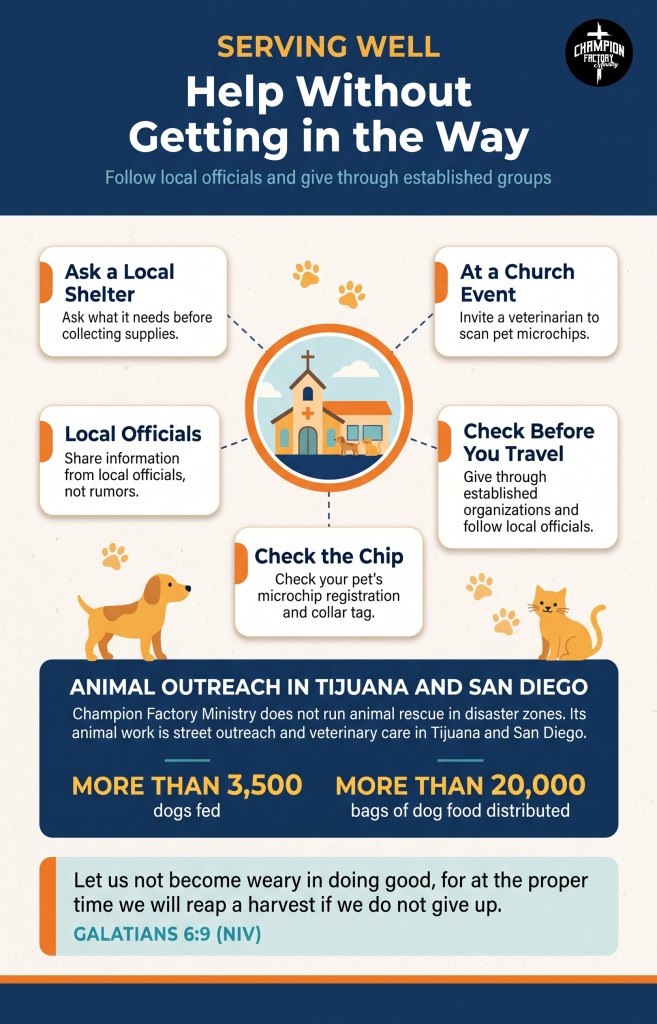
- Ask a local shelter what it needs before collecting supplies.
- Invite a veterinarian to scan pet microchips at a church event.
- Share information from local officials, not rumors.
Ways to Serve Without Pressure
If you want to support animal care the ministry already does, you can learn about ways to give or volunteer. Give only what fits your means and your convictions.
Care That Continues After the Rescue Ends
The rescue is the part everyone sees. The weeks after are where most of the work happens: care, searching, waiting, and finding a safe home. The ministry approaches people the same way. When a fire destroyed eight homes in a small Mexican community, the ministry distributed truckloads of clothing and blankets, plus food, hygiene supplies, and financial support for temporary housing within days. Neighbors began sharing resources, and families started rebuilding homes and trust.
Your next step can be small. This week, check your pet's microchip registration and collar tag. Then ask one local shelter what it needs. If you are waiting for news of a lost pet, pray for patience and call the shelter.
FAQ
Does a Microchip Help Cats as Much as Dogs?
In the same national shelter study, microchipped cats were returned to their owners 38.5 percent of the time, against 1.8 percent for cats without microchips. That study covered general shelter intake, and a chip does not guarantee a reunion.
Can Rescued Animals Be Sent to Other States?
Yes. After Hurricane Katrina, rescued pets were flown across the country because shelters in the region were overwhelmed. If your animal was moved, ask the shelter where it went.
Do Rescued Animals Get Veterinary Care?
CDC interim guidance covers calm handling and microchip scans at intake. Treatment after that is up to the shelter and its partners, so ask what care it can give and whether costs apply.