



Hebrews 11 is part of a longer letter written to a community of early Christians under real pressure. They faced persecution for their faith and were considering turning back to their previous religious practice to escape it. The author wrote chapter 11 as a direct response to people who were tired, afraid, and needed a reason to hold on.
The book of Hebrews does not name its author, though it has long been associated with the apostle Paul. Most scholars today hold that question open. What is clear is that the letter was written before the destruction of the Jerusalem temple in A.D. 70, and that its audience was a specific community in a specific crisis.
That context matters. Hebrews 11 is written for people who have already paid a cost for what they believe and are asking whether it is worth continuing. That is why the chapter is so direct and why its honesty about suffering and unfulfilled promises stands out.
What Does Hebrews 11:1 Actually Mean?
Hebrews 11:1 defines faith as "the assurance of things hoped for, the conviction of things not seen" (ESV). The word translated "assurance" carries the sense of a firm foundation. The word translated "conviction" means evidence or proof. The verse says that faith itself functions as the evidence of what is not yet visible. It is a settled confidence, not wishful thinking.
The Greek word for faith used throughout this chapter is pistis, meaning trust, firm persuasion, or reliance. It is not the same as believing something without reasons. It is closer to the kind of trust you place in a person whose character you know well, acting on that trust before you can see the full outcome.
Different Bible translations render this verse in slightly different ways. The NIV says "confidence in what we hope for and assurance about what we do not see." The CSB says "reality of what is hoped for, the proof of what is not seen." Reading two or three translations side by side can help the verse open up.
Hebrews 11:6 adds a companion definition: "Without faith it is impossible to please God, for whoever would draw near to him must believe that he exists and that he rewards those who seek him." Faith involves two things. Believing that God is real. And believing that he is genuinely good toward those who seek him.
What Faith Is Not
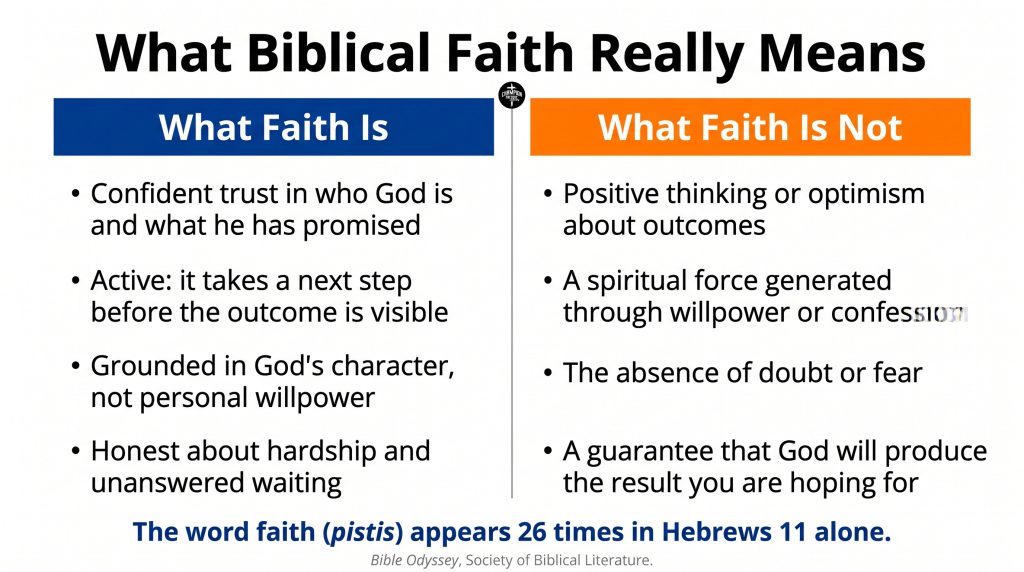
Biblical faith as Hebrews 11 describes it is not:
- Positive thinking or optimism about outcomes
- A spiritual force you generate through willpower or confession
- The absence of doubt or fear
- A guarantee that God will produce the specific result you are hoping for
The word faith (pistis) appears approximately 26 times in Hebrews 11 alone, according to Bible Odyssey, a resource of the Society of Biblical Literature. That concentration is intentional. The author is not using faith as a vague spiritual term. Every use is specific and grounded in a real person responding to a real situation.
Who Are the People Listed in Hebrews 11?
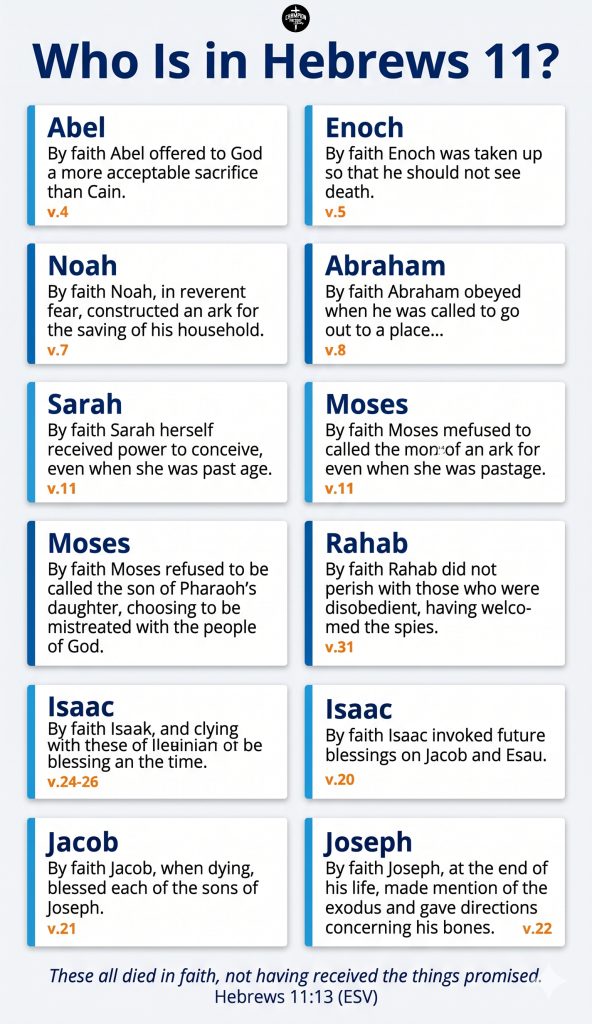
Hebrews 11 names 16 specific individuals and references the faith of others without naming them, covering centuries of history from creation through the period of the Maccabees. The list includes Abel, Enoch, Noah, Abraham, Sarah, Isaac, Jacob, Joseph, Moses, and Rahab. What makes this list worth studying is not how exceptional these people were. Several had significant failures. What Hebrews commends is their posture toward God in specific moments.
Here is a plain summary of what the chapter says about several key figures.
- Abel brought a sacrifice by faith and was commended as righteous (v. 4). He is also the first martyr in scripture.
- Noah built an ark by faith in response to a warning about something he could not yet see (v. 7).
- Abraham left his home by faith without knowing where he was going (v. 8). Later, he prepared to offer his son Isaac by faith, trusting that God could raise the dead (v. 17-19).
- Sarah received strength to conceive by faith, even past the age of childbearing, because she considered God faithful to his promise (v. 11).
- Moses chose to be identified with a suffering people rather than enjoy the comfort of Pharaoh's household (v. 24-26). He kept moving by faith even when the outcome was not visible.
- Rahab welcomed the Israelite spies by faith and was spared when Jericho fell (v. 31).
Sarah and Rahab are the only two women named individually in the chapter, though verse 35 references unnamed women who received their dead raised to life. Their presence in the list is theologically significant. The chapter does not restrict faith to leaders, priests, or people with obvious social standing.
Verses 35 through 38 describe anonymous believers who suffered greatly and did not receive deliverance in their lifetimes. The author says the world was not worthy of them. These verses are not footnotes. They are part of the point.
What Hebrews 11:13 Says About Faith in Hard Seasons
Hebrews 11:13 says, "These all died in faith, not having received the things promised, but having seen them and greeted them from afar." The author is not glossing over the gap between what the faithful hoped for and what they experienced. He is naming it directly. Biblical faith does not promise that God will deliver every specific outcome before a person's life ends.
This verse is rarely the focus of articles about Hebrews 11. Most treatments emphasize the dramatic acts of the named figures without pausing here. For anyone reading this in a season of genuine hardship, this verse may be the most important one in the chapter.
"We have sat with people who prayed for years without seeing what they hoped for. Hebrews 11:13 does not pretend that never happens. That honesty is part of what makes it trustworthy." Todd Medina, President & Founder, Champion Factory Ministry
According to research by the Barna Group, 65% of Americans who identify as Christian say they have experienced a period of spiritual doubt at some point. Most people who take faith seriously will eventually face a season where the promise seems far away. Hebrews 11:13 does not pretend otherwise.
What the verse does not say is that the faithful were wrong to trust. It says they saw the promises from a distance and welcomed them. Their faith was real and grounded even when the outcome they waited for was not visible in their lifetime.
This stands in direct contrast to the prosperity gospel teaching that enough faith will produce the specific result you want. That reading cannot survive an honest look at Hebrews 11. The author commends people who trusted God through suffering, loss, and death, and still holds up their faith as the example worth following.
What the Cloud of Witnesses Means for Life Today
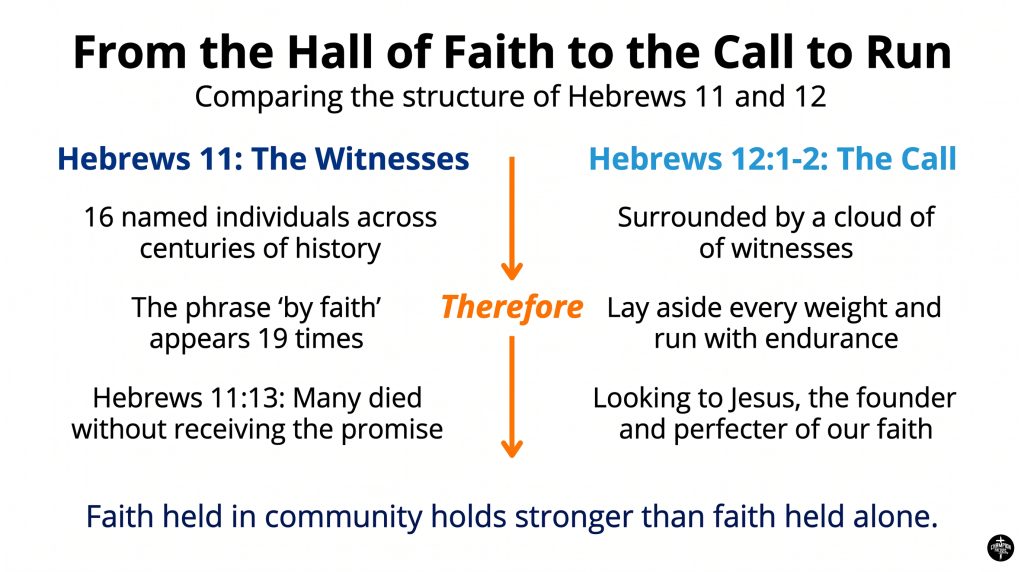
Hebrews 12:1 opens with "Therefore, since we are surrounded by so great a cloud of witnesses, let us also lay aside every weight, and sin which clings so closely, and let us run with endurance the race that is set before us." The cloud of witnesses refers directly to the people named in chapter 11. Their lives serve as testimony. The practical call is to run with endurance, not to perform spiritual perfection.
The word "therefore" in Hebrews 12:1 connects directly to everything in chapter 11. The logic is clear. Look at all these people who trusted God through impossible circumstances. Now keep going.
"The cloud of witnesses is not a gallery of the spiritually elite. It is a record of people who chose to trust God across every kind of circumstance. That record is meant to move us forward." Art Montgomery, Global Evangelism Strategy Architect & Board Visionary Luminary, Champion Factory Ministry
The phrase "run with endurance" matters. Endurance is not excitement or peak spiritual performance. It is continuing when you would rather stop. The chapter does not call readers to be extraordinary. It calls them to keep going.
According to a 2024 survey by the American Psychiatric Association, 60% of U.S. adults say their faith or spirituality is an important factor in their mental wellness. The kind of trust Hebrews 11 describes, grounded in relationship rather than outcomes, does not depend on circumstances going well.
Hebrews 12:2 points to Jesus as "the founder and perfecter of our faith." The race is not run alone.
Faith Is Not Produced by You Alone
One of the most common struggles for people reading Hebrews 11 is feeling that they lack what the chapter describes. If faith is the requirement, and you cannot seem to produce enough of it, the chapter can feel like another standard you are failing to meet. Scholars at Enter the Bible, a resource of Luther Seminary, point out that faith is called into being by God's word, not manufactured by human effort.
The people commended in Hebrews 11 were not exceptional producers of spiritual confidence. Noah built an ark before rain had ever fallen. Abraham left without knowing where he was going. Moses gave up wealth and comfort for a people who were not yet free. In each case, they responded to something God had said or shown them. The faith came first. The visible outcome came later, and sometimes not at all in their lifetimes.
If you are in a season where faith feels thin, that does not disqualify you from the conversation. It puts you in the same company as nearly every person in this chapter.
How to Engage with Hebrews 11 in a Meaningful Way
If you want to read this chapter in a way that does more than inform, here are some practical starting points.
- Read the full chapter in one sitting. Use a translation you find readable, such as the ESV, NIV, or CSB. Bible Gateway offers free access to multiple translations in one place.
- Notice the phrase "by faith" each time it appears. It precedes a specific action or posture. Count the 19 occurrences and read what follows each one.
- Sit with verse 13. If you are in a hard season, read it slowly. Let the honesty of it land before moving on.
- Read Hebrews 12:1-2 immediately after. The connection between those two chapters is the author's main point.
- Talk about what you read with someone. Faith in Hebrews is not isolated. It is lived in community and carried forward by shared story.
Our discipleship and mentorship programs at Champion Factory Ministry are built for people working through exactly this kind of long-term journey. Faith rarely grows in isolation, and we walk alongside people through seasons that do not resolve quickly.
Staying in the Race When the Outcome Is Not Yet Visible
Hebrews 11 does not end with a triumph. It ends with a list of unnamed people who did not receive what they waited for, described as people the world was not worthy of. Then the next chapter says: look at all of them, and keep running.
That is the message of a letter written for people who are afraid, exhausted, and asking whether it is worth continuing.
Biblical faith, as Hebrews 11 presents it, is not certainty about outcomes. It is grounded trust in who God is. It is not passive. It takes a next step without seeing the full picture. It does not require a perfect record. The people in this chapter were flawed, afraid, and human. What they shared was a decision to keep trusting.
If you are carrying something heavy right now, you do not have to carry it alone. We would be glad to connect with you. Reach out to us here or learn more about how to get involved.
FAQ
Is Hebrews 11 called the Hall of Faith?
Hebrews 11 is commonly called the Hall of Faith or Faith Hall of Fame because it lists figures from the Old Testament who are commended for their trust in God. The label can be misleading if it suggests these were exceptional or distant figures. The chapter presents them as ordinary people who responded to God in specific moments.
Who wrote the book of Hebrews?
The author of Hebrews is not named in the text. It has traditionally been attributed to the apostle Paul, but that attribution has been debated since the second century. Most scholars today leave the question open. What is clear is that the letter was written before A.D. 70 to a community of Jewish Christians facing significant pressure to abandon their faith.
What does "by faith" mean in Hebrews 11?
The phrase "by faith" introduces each example in the chapter and appears 19 times. It signals that the action or posture described was a direct response to trust in God, not the result of favorable circumstances or personal strength. Faith in this chapter is always active. It produces a concrete response.
Does Hebrews 11 say that faith always produces the results we pray for?
No. Hebrews 11:13 says directly that many of the faithful "died in faith, not having received the things promised." The chapter commends their trust even when visible outcomes did not arrive in their lifetime. This is one of the clearest places in the Bible where faith is separated from guaranteed results.
Who are the women named in Hebrews 11?
Sarah and Rahab are the only two women named individually in Hebrews 11. Sarah is commended for trusting that God would fulfill his promise of a child, even past the normal age of childbearing. Rahab is commended for welcoming the Israelite spies by faith when Jericho was about to fall. Verse 35 also references unnamed women who received their dead raised to life.
What is the cloud of witnesses in Hebrews 12:1?
The cloud of witnesses in Hebrews 12:1 refers to the faithful people described in Hebrews 11. Their lives serve as testimony and encouragement for those who follow. Their stories, preserved in scripture, bear witness to what trust in God looks like across generations.