






Many people encounter John 10 at a moment when they need it most. They may be questioning their faith, carrying pain they have not been able to name, or simply wondering whether the promises they have heard in church are real. John 10 speaks directly into that space.
This article walks through what Jesus actually says in John 10, what it meant for the people who first heard it, and what it means for believers today. The goal is clarity without complexity, and encouragement without false promises.
What Is John 10 About?
John 10 is Jesus' extended teaching on what it means to truly belong to God. He uses the everyday image of a shepherd and his flock to explain His identity, His purpose, and the kind of care He offers. The chapter covers His role as the Gate, His role as the Good Shepherd, and His unity with the Father. It is one of the most personal descriptions of God's relationship with His people in all of the Gospels.
The chapter opens immediately after Jesus heals a blind man, a healing the religious leaders had rejected and condemned. His audience in John 10 includes those same leaders, a crowd of skeptics, and His own followers. The tension in the room matters. Jesus is not giving a quiet devotional talk. He is making a bold claim about who He is in the middle of significant opposition.
Two things make John 10 especially important for understanding the Gospel of John. First, it contains two of the seven "I Am" declarations Jesus makes throughout the book, each one a direct claim to divine identity rooted in the Old Testament name of God. Second, it is set against the backdrop of the Feast of Dedication, the Jewish celebration we know today as Hanukkah, a holiday marking the rededication of the temple. Jesus is present and speaking at the very moment His people are remembering God's faithfulness.
What Does It Mean That Jesus Is the Gate?
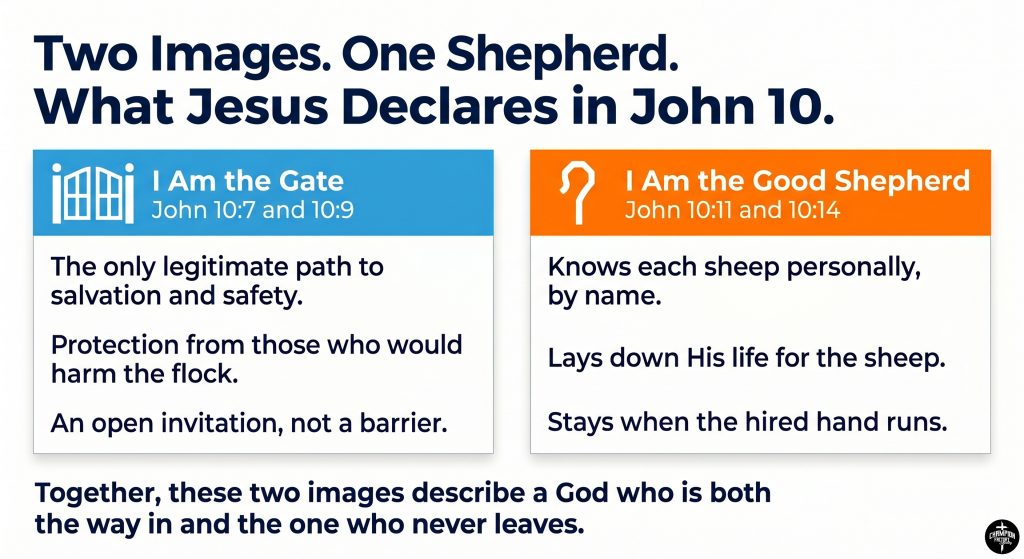
Jesus says in John 10:7 and 10:9, "I am the gate for the sheep" and "whoever enters through me will be saved." The gate in this image is not a barrier. It is the point of entry that leads to safety, nourishment, and freedom. To enter through the gate means to come to God through Christ and to find genuine protection and rest on the other side.
In the ancient world, a shepherd would often sleep in the entrance of the sheepfold at night, physically becoming the gate. Nothing could get in or out without going through the shepherd himself. Jesus uses this image to make a specific point: there are others who claim to offer what only He can provide. He calls them thieves and robbers, those who approach the flock without the shepherd's authority and with no concern for the sheep.
Scholars at Luther Seminary's Working Preacher note that the gate metaphor is not an image of exclusion. It is not a license to view those outside the fold as enemies. It is an invitation. The gate stands open. Anyone can enter. What the gate makes clear is that there is a genuine path to safety and there are counterfeit ones, and the difference matters enormously for the people walking through them.
For a reader who has been burned by false promises or misleading voices, this is stabilizing. Jesus is not one option among many. He is the legitimate shepherd who enters through the proper gate, calls His sheep by name, and leads them out into open pasture.
What Does "Abundant Life" Actually Mean in John 10:10?
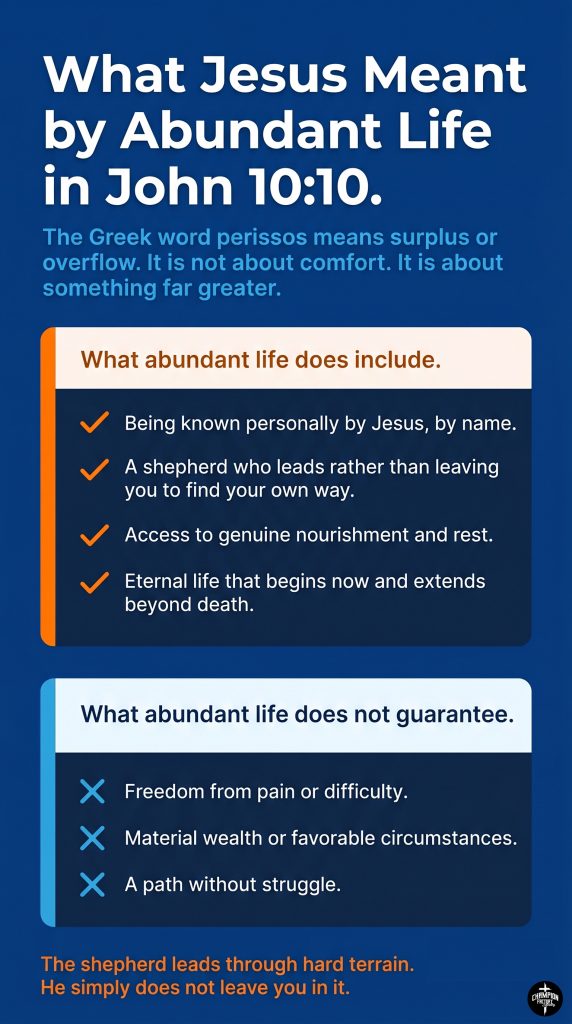
John 10:10 records Jesus saying, "The thief comes only to steal and kill and destroy. I have come that they may have life, and have it to the full." The word translated "to the full" or "abundantly" comes from the Greek word perissos, which carries a mathematical sense of surplus or overflow. Jesus is not describing a life of material comfort or ease. He is describing a life of genuine fullness, one defined by being deeply known, truly secure, and connected to God now and into eternity.
This verse is one of the most quoted in scripture and also one of the most misunderstood. It has been used to suggest that following Jesus guarantees financial prosperity, physical health, or freedom from hardship. That reading misses the contrast Jesus is drawing. The abundant life stands opposite to what the thief produces: theft, destruction, and death. The shepherd's life is the opposite of those things, not because it is easy but because it is real, protected, and accompanied.
David Platt, a pastor and author at Radical.net, puts it plainly: following Jesus is not settling for less than the world offers. It is choosing something greater than what the world can provide. The abundance Jesus promises is not comfort at the expense of meaning. It is meaning, security, and belonging that outlast every hardship.
What the abundant life does include, based on the wider context of John 10:
- Being known personally by Jesus, not as a category but by name
- Having a shepherd who leads, rather than leaving the sheep to find their own way
- Access to pasture, which the text uses to describe genuine nourishment and rest
- Eternal life, which begins now and extends beyond death
What the abundant life does not guarantee:
- Freedom from pain or difficulty
- Material wealth or favorable circumstances
- A path without struggle
This matters especially for anyone who has been told that their hardship is a sign of insufficient faith. John 10 says nothing of the kind. The Good Shepherd leads His sheep through terrain that is not always safe. He simply does not abandon them in it.
Who Is the Good Shepherd and Why Does It Matter?
In John 10:11, Jesus says, "I am the good shepherd. The good shepherd lays down his life for the sheep." This declaration carries more weight than a warm image. It is a direct claim to be the God of Psalm 23, the shepherd of Israel that the Old Testament promised. It is also a prediction of the cross. The chapter that describes belonging and safety is also the chapter where Jesus explains that He will die for the people He protects.
The connection to Psalm 23 is not accidental. Biblical scholars widely recognize John 10 as the New Testament fulfillment of that psalm. Where Psalm 23 describes the Lord as shepherd who leads, restores, and walks with His people through the valley, John 10 names that shepherd as Jesus. The theology is continuous. The person is now revealed.
Jesus also draws a clear contrast between Himself and a hired hand. A hired hand runs when danger arrives. He has no personal stake in the sheep. The Good Shepherd stays. He knows His sheep, and His sheep know Him. That two-way knowing is the heart of the relationship Jesus describes. It is a relationship built on familiarity and trust, not a formal transaction.
In John 10:16, Jesus adds something that surprises His audience. He has other sheep, not of this fold, who will also hear His voice and come. This is a reference to the future inclusion of Gentiles in God's family. The flock is not closed. The shepherd is actively calling others in. No one is beyond the reach of that call.
"John 10:16 has always been at the heart of our global work. The shepherd is calling people across every border and background. That call does not stop at the edge of a familiar community." Art Montgomery, Global Evangelism Strategy Architect and Board Visionary Luminary, Champion Factory Ministry
What Does It Mean to Hear Jesus' Voice Today?
Jesus tells His followers that His sheep hear His voice, and they follow Him because they know it. For believers today, this raises a practical and personal question: how does someone recognize and follow the voice of Christ in ordinary life, when other voices are louder, competing, or more immediately compelling?
The text does not provide a simple formula. It does provide a framework.
Sheep in the ancient world learned their shepherd's voice through repeated exposure. They knew the sound because they had followed it before. Hearing Jesus' voice today is cultivated the same way, through scripture, prayer, community, and the practice of paying attention to what aligns with His character.
Practical anchors from John 10 and its context:
- The shepherd's voice leads toward nourishment and safety, not toward harm or shame.
- The shepherd calls each sheep by name. The relationship is personal, not generic.
- The sheep flee from a stranger's voice because it does not sound familiar. Cultivating familiarity with scripture and trusted community makes discernment more reliable over time.
- The shepherd does not drive the sheep. He walks ahead and they follow. There is movement and direction, but no coercion.
For anyone in a hard season, wondering whether God is present or speaking, the chapter offers this: the shepherd is not silent. He is calling. And the relationship He offers is one of genuine knowing, not distant management.
If you are in a season of seeking and want support in your faith journey, Champion Factory Ministry's Nourish discipleship program offers structured community and spiritual growth resources for people at every stage.
Can Anything Separate a Believer from God?
John 10:28-29 records Jesus saying, "I give them eternal life, and they shall never perish; no one will snatch them out of my hand. My Father, who has given them to me, is greater than all; no one can snatch them out of my Father's hand." Biblical scholars note that the original Greek uses an emphatic double negative, the strongest possible grammatical construction, to express that this security is absolute. Nothing external can remove a true believer from God's protection.
This is not a license for careless living. It is a statement about the nature of God's grip, not the nature of human effort. The security of the believer rests on the power of the shepherd, not the strength of the sheep. A sheep that wanders is still known. A sheep that is frightened is still held.
For anyone who has spent years wondering whether their faith is sufficient, whether their doubt disqualifies them, or whether they have drifted too far to return, this passage is worth sitting with. The shepherd's hand is described as stronger than any force that would try to pull the sheep away.
John 10:30, where Jesus declares "I and the Father are one," closes the theological loop. The same God who created and sustains everything is the one holding His people. The security is not sentimental. It is grounded in divine authority.
The Connection Between John 10 and Psalm 23
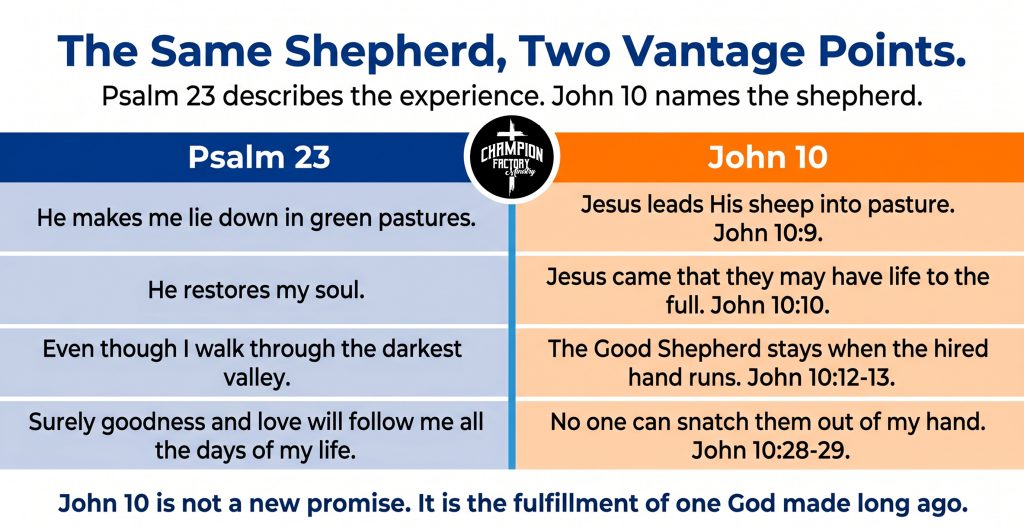
Psalm 23 and John 10 tell the same story from two different vantage points. Psalm 23 describes the experience of being led, restored, and accompanied by a faithful shepherd through every season of life. John 10 names that shepherd as Jesus and explains what His care cost Him. Together, they form one of the most complete pictures of God's relationship with His people in all of scripture.
For many believers, Psalm 23 is deeply familiar. It is read at funerals, quoted in hard moments, and memorized in childhood. John 10 is its explanation. Where Psalm 23 says "the Lord is my shepherd," John 10 shows what that shepherd looks like in person.
Places where the two passages speak to each other:
- "He makes me lie down in green pastures" connects to Jesus leading His sheep into pasture in John 10:9
- "He restores my soul" connects to the abundant life Jesus describes in John 10:10
- "Even though I walk through the darkest valley" connects to the shepherd who stays when the hired hand runs in John 10:12-13
- "Surely goodness and love will follow me all the days of my life" connects to the eternal security of John 10:28-29
Reading John 10 alongside Psalm 23 helps the familiar become theologically grounded, and helps the theologically rich become personally warm.
Living as a Sheep Who Belongs: Steps to Receive What John 10 Promises
John 10 is not only a chapter to understand. It is a chapter to receive. The promises Jesus makes are not reserved for a future state or a more spiritually advanced version of the reader. They are available now, to anyone who follows the shepherd's voice.
"Belonging has to be modeled. We try to walk alongside people the way the Good Shepherd does: by name, consistently, and through the hard parts." Todd Medina, President and Founder, Champion Factory Ministry
A few ways to engage with the chapter practically:
- Read John 10 slowly, in one sitting, in a translation you find accessible. Notice which verse stops you. That is likely the one that matters most right now.
- Compare it to Psalm 23. Read both in the same sitting and notice what each passage adds to the other.
- Identify one promise from the chapter that feels hard to believe today. Bring that specific promise into prayer, honestly and without performance.
- Find or stay connected to a community that reflects the shepherd's care. John 10 describes a flock, not a solo journey. Belonging to a faith community is part of what the shepherd provides, not optional decoration on the Christian life.
- If you are carrying pain, uncertainty, or doubt, remember that the sheep in John 10 do not follow the shepherd because they have everything figured out. They follow because they recognize His voice.
According to the American Psychiatric Association, about one in three U.S. adults reported experiencing loneliness at least once a week in 2024. That finding reflects something the shepherd's image addresses directly: the hunger to be known and to belong somewhere. John 10 says that hunger is not a weakness. It is exactly what the Good Shepherd came to meet.
If you are looking for community or want to serve alongside others who take the shepherd's care seriously, we invite you to get involved with Champion Factory Ministry.
FAQ
What is the main message of John 10?
John 10 teaches that Jesus is the Good Shepherd who knows His people personally, protects them completely, and gives His life for them. The chapter also presents Jesus as the Gate, the only legitimate entry point to salvation and safety. Together, these images describe a relationship of genuine care, belonging, and eternal security.
What does "abundant life" mean in John 10:10?
The Greek word behind "abundantly" is perissos, which means surplus or overflow. Jesus is not promising wealth or ease. He is promising a life of genuine fullness: being deeply known, spiritually nourished, and held securely by God. This kind of abundance can coexist with hardship because it is rooted in relationship, not circumstances.
Who is the "thief" in John 10:10?
Most biblical scholars understand the thief to refer to false teachers and misleading spiritual voices who approach God's people without genuine care or authority. Some also see a reference to the spiritual forces of destruction more broadly. The contrast Jesus draws is clear: the thief takes. The shepherd gives.
What does Jesus mean when He calls Himself the Gate?
Jesus says He is the gate through which the sheep enter for safety and go out to find pasture. As the Gate, He is the legitimate and only path to salvation and relationship with God. The image is not one of exclusion but of protection. The gate stands between the sheep and those who would harm them.
Can a Christian lose their salvation based on John 10?
John 10:28-29 uses the strongest possible Greek grammatical construction to say that no one can snatch a believer from the hand of Jesus or the hand of the Father. This passage is one of the clearest statements of eternal security in the New Testament. The believer's safety rests on the power of the shepherd, not on the consistency of the sheep.
How is John 10 connected to Psalm 23?
John 10 is widely recognized as the New Testament fulfillment of Psalm 23. Where Psalm 23 describes the faithful shepherd who leads, restores, and accompanies God's people through every season, John 10 names that shepherd as Jesus and reveals what His care ultimately cost Him. Reading them together gives a fuller picture of God's relationship with His people.