




Deuteronomy has 34 chapters, and much of it is law. Many readers open it, meet a long list of rules, and wonder how it fits the rest of the Bible or their own lives. That reaction is common, and it is a good reason to start with a clear guide.
This article explains what the book is, how it is organized, and why Jesus quoted it. You will also see what it says about caring for neighbors and teaching the next generation, and you will leave with a simple way to start reading.
What Is the Book of Deuteronomy About?
The Book of Deuteronomy records Moses' final speeches to Israel on the Plains of Moab, east of the Jordan River. The people had spent forty years in the wilderness and were about to enter the Promised Land. Moses retells their story, restates God's teaching, and calls them to love God, teach their children, and care for those in need.
Deuteronomy is the fifth and last book of the Torah, the first five books of the Bible. The name comes from the Greek word deuteronomion, meaning second law. The Hebrew title, Devarim, means words and comes from the book's opening line.
The title does not mean a new set of rules. The book restates and expands teaching God had already given. Moses speaks to a generation that grew up in the wilderness. He knows Joshua will lead them into the land, not him.
Britannica describes the book as no dry legal code but, rather, a book written in fluent and moving prose. It reads like a farewell address from a leader who loves his people.
Jewish and Christian tradition credits Moses with the book. Scholars who study its composition often place the writing between the 7th and 5th centuries BCE. Readers hold both views, and this article does not argue for either.
How Is Deuteronomy Organized?
Deuteronomy is commonly outlined as three speeches by Moses followed by closing chapters. The first speech reviews Israel's journey. The second restates God's teaching and laws. The third calls the people to choose faithfulness. The last chapters cover the Song of Moses, the commissioning of Joshua, and the death of Moses.
Here is a simple map for first-time readers:
- Deuteronomy 1:1-4:43. Moses reviews the journey from Mount Sinai to Moab.
- Deuteronomy 4:44-29:1. Moses restates the Ten Commandments (chapter 5) and the laws in chapters 12-26.
- Deuteronomy 29:2-30:20. Moses calls the people to renew their commitment to God.
- Deuteronomy 31:1-34:12. Joshua is commissioned, Moses shares a song and blessings, and Moses dies.
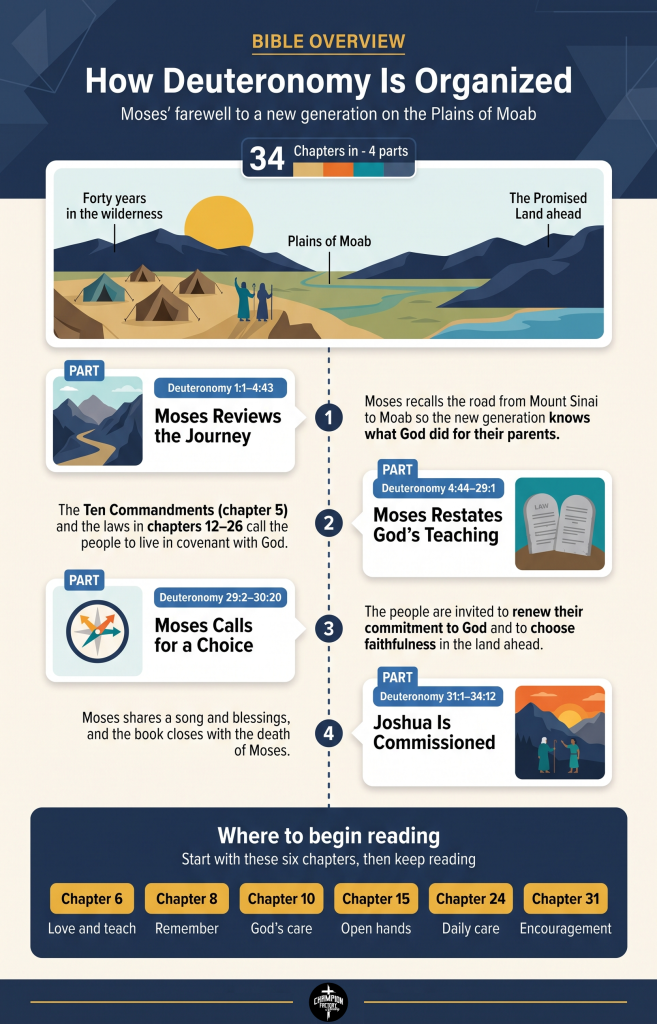
Scholars outline the book in slightly different ways. This map gives a first-time reader a starting point.
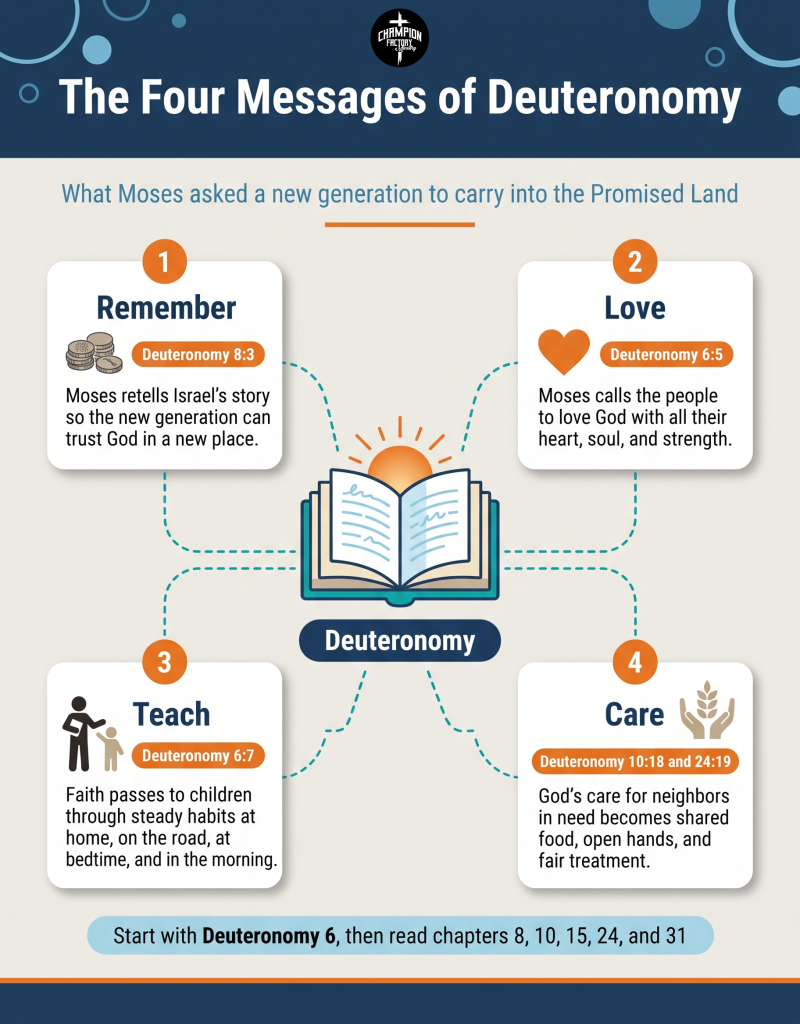
Moses retells Israel's story on purpose. Chapters 1 to 3 recall the journey from Mount Sinai to Moab so the new generation knows what God did for their parents. Memory is a central theme of the book, and remembering gives the people a reason to trust God in a new place.
Why Did Jesus Quote Deuteronomy?
Jesus quoted Deuteronomy at key moments in the Gospels. He named Deuteronomy 6:5, the call to love God fully, as the greatest commandment (Matthew 22:34-40). He also answered temptation in the wilderness with words from Deuteronomy 8:3 (Matthew 4:4). These moments show that Jesus knew and valued this book.
Moses gave the call to love God as part of a passage known as the Shema:
"And you shall love the LORD your God with all your heart and with all your soul and with all your strength." (Deuteronomy 6:5, BSB)
In the wilderness, Jesus drew on a line from Moses' reminder of Israel's own wilderness years. Deuteronomy 8:3 says that "man does not live on bread alone, but on every word that comes from the mouth of the LORD." The verse does not dismiss daily needs. It reminds readers that people need more than food to live well.
What Does Deuteronomy Say About Caring for People in Need?
Deuteronomy tells God's people to care for neighbors who have little protection, including the poor, the fatherless, the widow, and the foreigner. This care is practical. The book calls for shared food, open-handed giving, and fair treatment. It grounds this care in God's own character.
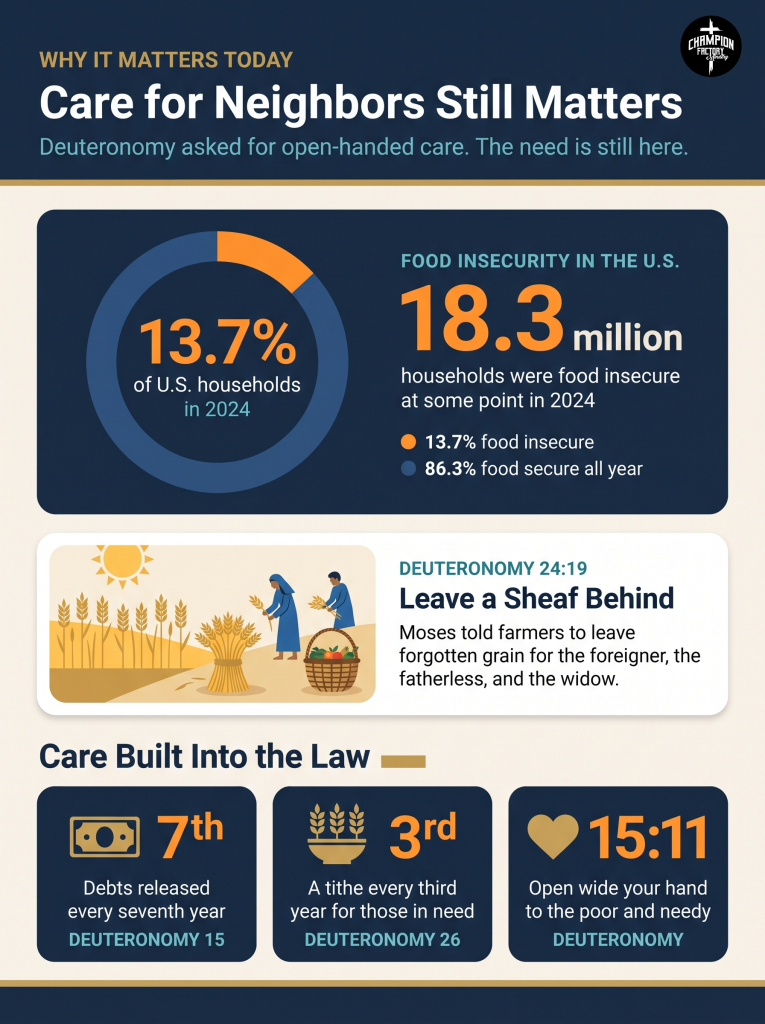
Yale professor Christine Hayes notes that Deuteronomy also emphasizes social justice and personal ethics and neighborly responsibility. The care is built into daily and seasonal life. Deuteronomy 15 calls for debts to be released every seventh year and tells lenders not to refuse the poor. Deuteronomy 26 directs a tithe every third year to the Levite, the foreigner, the fatherless, and the widow.
Biblical Perspective
Moses grounds this care in who God is:
"He executes justice for the fatherless and widow, and He loves the foreigner, giving him food and clothing." (Deuteronomy 10:18, BSB)
He also gives a plain, practical example:
"If you are harvesting in your field and forget a sheaf there, do not go back to get it. It is to be left for the foreigner, the fatherless, and the widow, so that the LORD your God may bless you in all the work of your hands." (Deuteronomy 24:19, BSB)
Deuteronomy 15:11 adds a direct command to "open wide your hand to your brother and to the poor and needy in your land." The command is to open a hand.
Why It Still Matters
Need is still present today. The USDA Economic Research Service reports that 13.7 percent of U.S. households, about 18.3 million, were food insecure at some point in 2024. USDA defines food insecurity as a household being unsure it can get enough food because money or other resources run short.
"People want to be asked what they need before anyone decides for them. Steady, respectful care builds trust over time." Art Montgomery, Global Evangelism Strategy Architect & Board Visionary Luminary
Simple ways to put this care into practice:
- Give regularly to a local food pantry or community meal.
- Share a meal with a neighbor who lives alone.
- Ask what someone needs before you offer help.
- Volunteer with a group that serves children and families.
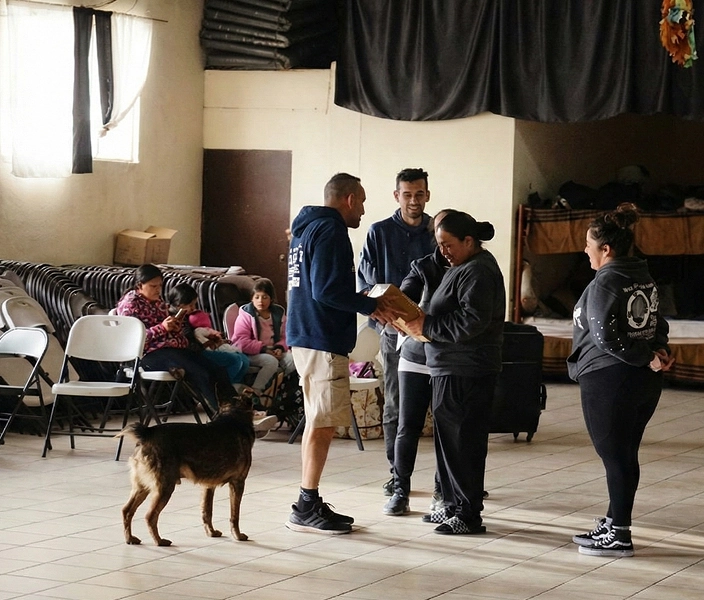
Champion Factory Ministry puts this kind of care into practice through food and essential care outreach and mentorship for children and families.
How Does Deuteronomy Call Us to Teach the Next Generation?
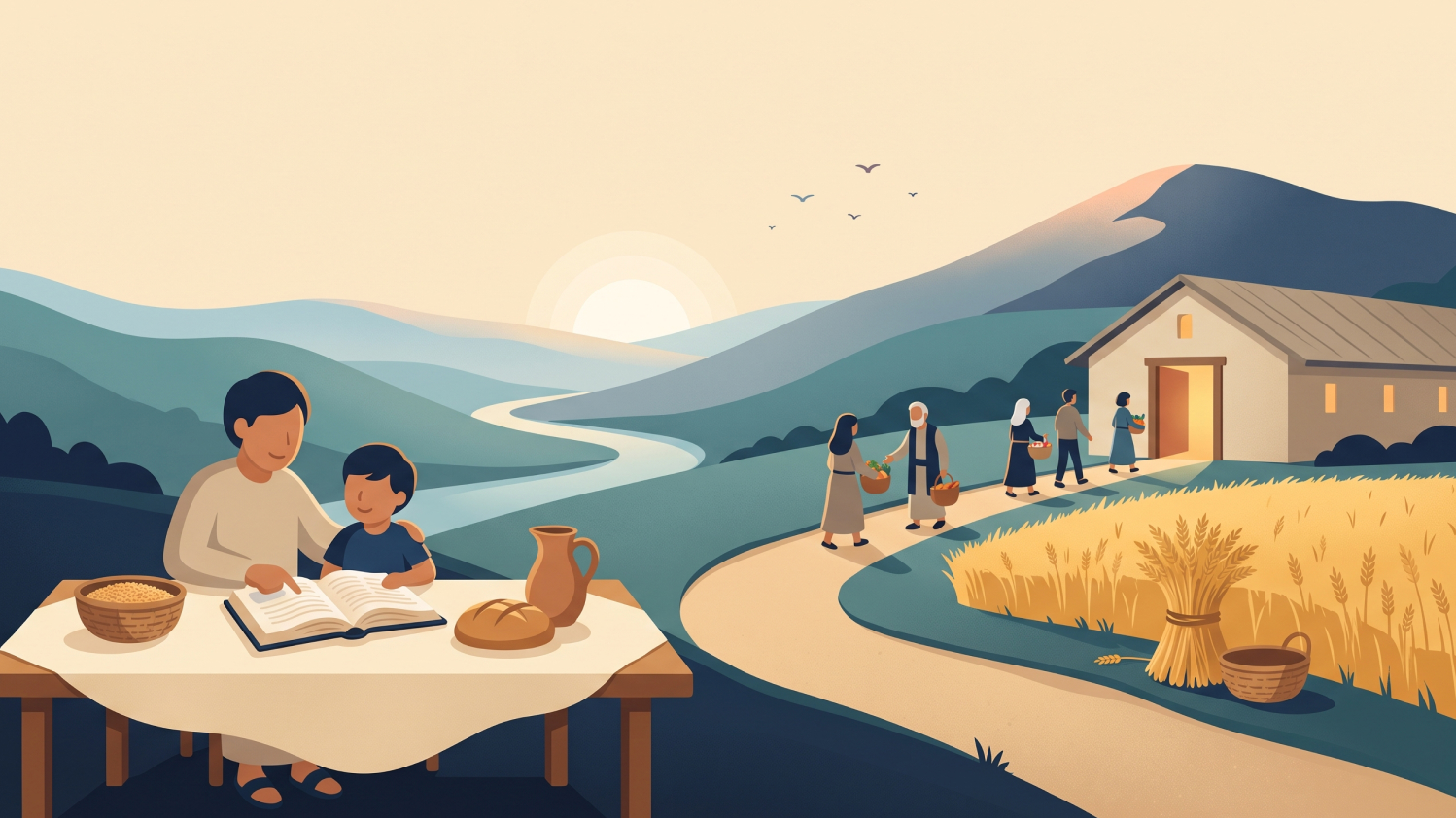
Deuteronomy asks parents to teach God's words to their children in everyday life. Moses describes conversation at home, on the road, at bedtime, and in the morning. Faith passes to the next generation through steady habits and honest answers to questions. Mentors and church families share that work.
Moses puts it this way:
"And you shall teach them diligently to your children and speak of them when you sit at home and when you walk along the road, when you lie down and when you get up." (Deuteronomy 6:7, BSB)
Deuteronomy 31 also calls for the law to be read aloud to the whole community every seventh year. The whole community shares the teaching. Mentors, teachers, and church families can use the same habits.
"Faith grows in ordinary moments. When a child watches an adult read a verse, ask a question, and pray, that child learns faith belongs to daily life." Todd Medina, President & Founder
Ways to begin:
- Read one short passage together, such as Deuteronomy 6:4-9.
- Ask open questions and welcome honest answers.
- Share how faith has helped you, including in hard times.
- Keep it short and regular.
How Should You Read the Hard Parts of Deuteronomy?
Read Deuteronomy slowly and in context. It was spoken to a nation about to enter a new land, and it includes hard laws and warnings. Start with the passages on love, memory, and care for neighbors. Bring questions to a pastor or study group. Do not read the book's warnings as proof that any person's suffering is deserved.
A Simple Reading Order
Try these chapters first:
- Deuteronomy 6, on loving God and teaching children
- Deuteronomy 8, on remembering God's care
- Deuteronomy 10, on God's care for people without protection
- Deuteronomy 15, on open-handed generosity
- Deuteronomy 24, on practical care in daily life
- Deuteronomy 31, on encouragement as leadership changes
Blessings and Curses in Context
In chapters 27 and 28, Moses describes consequences for the nation if it keeps or abandons its covenant with God. These chapters were addressed to a whole people in a specific moment. They do not teach that hunger, poverty, abuse, or trauma are punishments for the person who suffers. In John 9:1-3, Jesus declines to link a man's hardship to anyone's sin.
This article offers biblical background and encouragement. It does not replace counseling, medical care, or legal support. If you are facing a hard time, a pastor, counselor, or trusted professional can help.
"Scripture and professional care work side by side. If you are facing a hard time, please talk with a pastor and a licensed counselor." Art Montgomery, Global Evangelism Strategy Architect & Board Visionary Luminary
A Simple Next Step for Reading and Living Deuteronomy
Deuteronomy invites you to remember what God has done, love God, teach the next generation, and care for neighbors. A good first step is small. Read Deuteronomy 6 this week, pray over it, and share one idea with someone you trust.
Moses spoke to a community facing change. His words point to God's presence:
"Be strong and courageous. Do not be afraid or terrified of them, for it is the LORD your God who goes with you. He will never leave you nor forsake you." (Deuteronomy 31:6, BSB)
Here is a short prayer you can use: Lord, help me remember what you have done, love you fully, and open my hand to my neighbor. Amen.
If you want to serve, you can get involved or give to support families and children in your community.
FAQ
Who Wrote the Book of Deuteronomy?
Jewish and Christian tradition credits Moses. Scholars who study the book's composition often place the writing between the 7th and 5th centuries BCE. Readers hold both views.
What Does Deuteronomy Mean?
Deuteronomy comes from the Greek word deuteronomion, meaning second law. The book restates and expands earlier teaching. Its Hebrew title, Devarim, means words.
Is Deuteronomy Still Relevant for Christians Today?
Christians read it for its call to love God, remember his faithfulness, teach children, and care for neighbors. Jesus quoted it in Matthew 4:4 and Matthew 22:34-40. Christians hold different views on how Old Testament laws apply today, so a pastor or study group can help.
Where Should I Start Reading Deuteronomy?
Start with Deuteronomy 6, then read chapters 8, 10, 15, 24, and 31. These chapters carry the book's main themes of love, memory, care, and encouragement.