






Many people meet Jonathan Edwards through a single sermon with a frightening title, and they walk away thinking he was simply a preacher of fear. That picture is incomplete. The real Edwards was a thoughtful pastor, a devoted husband and father, and one of the most respected thinkers in American Christian history.
This article gives you the fuller and more accurate story. You will learn who Edwards was, the role he played in a season of widespread revival, what he actually taught about the heart, and why his ideas still help people who want a faith that feels real instead of rehearsed.
Who Jonathan Edwards Was
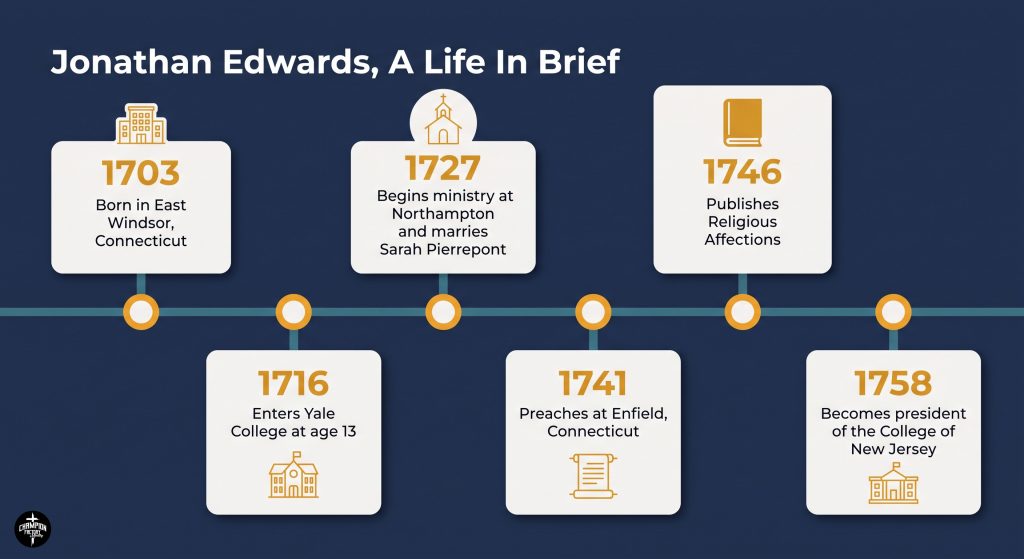
Jonathan Edwards was an American pastor, theologian, and philosopher who lived from 1703 to 1758. He spent most of his ministry in Northampton, Massachusetts, where he preached, wrote, and led a large congregation. He was known for a sharp mind, deep personal faith, and a quiet, steady manner that drew people toward God rather than driving them away.
Edwards entered Yale College at the age of 13 and graduated in 1720, then stayed on to study divinity. According to Encyclopaedia Britannica, he became colleague to his grandfather Solomon Stoddard at Northampton in 1727. That same year he married Sarah Pierrepont, and together they raised 11 children. His home life was warm, and his marriage was widely admired.
Edwards traced his own faith to a quiet moment of wonder. He described reading 1 Timothy 1:17 and feeling, for the first time, a deep sense of the glory of God. The verse reads, "Now to the King eternal, immortal, invisible, the only God, be honor and glory for ever and ever. Amen" (1 Timothy 1:17, NIV). He later viewed that experience as the true beginning of his life with God.
It also helps to remember that Edwards lived in the 18th century and shared some of the failings of his era, including the fact that he was a slaveholder. Honest readers can learn from his teaching while acknowledging that part of his life plainly. A clear-eyed view serves the truth better than either dismissal or a polished portrait.
Edwards and the First Great Awakening
Edwards helped lead and explain the First Great Awakening, a wave of Christian revival that spread through the American colonies and Britain in the 1730s and 1740s. Many people returned to active faith during this period. Edwards both witnessed these revivals firsthand and wrote carefully about what was real and lasting in them.
The revival began close to home. Edwards oversaw an early awakening in Northampton between 1733 and 1735. Britannica notes that during one six-month period, about 300 members were added to his church. He recorded these events in a widely read account titled A Faithful Narrative of the Surprising Work of God, published in 1737.
What set Edwards apart was not only that he saw revival, but that he studied it. He wanted to know which signs of spiritual change were genuine and which were only excitement that would fade. That careful, honest approach became one of his main contributions, and it shaped how later generations understood revival.
"Edwards understood something we see in outreach every day. A faith that moves the heart is a faith that moves toward people who need help." Art Montgomery, Global Evangelism Strategy Architect and Board Visionary Luminary
The Truth About "Sinners in the Hands of an Angry God"
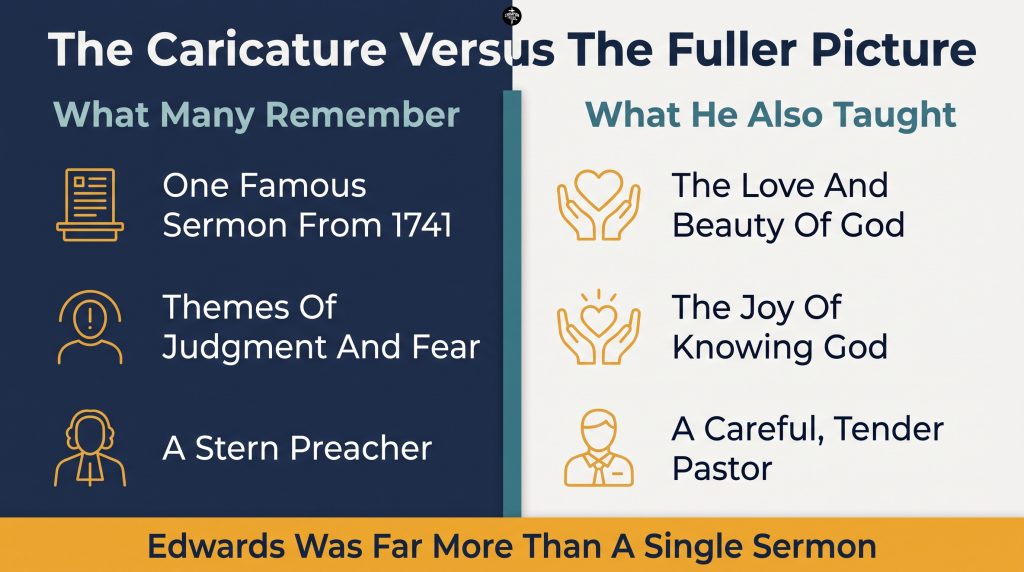
Edwards preached "Sinners in the Hands of an Angry God" on July 8, 1741, in Enfield, Connecticut. It became the most famous sermon of the period and the one work most people associate with him. Yet it represents only a small slice of his preaching, and judging him by it alone gives a distorted picture of the man and his message.
The sermon used vivid images of judgment to urge listeners toward repentance. It moved its hearers deeply in that setting, but it was never meant to summarize his life's work. Edwards preached far more often on themes like the love of God, the beauty of Christ, and the joy of knowing God.
Historians have said this for a long time. As one summary from EBSCO Research records, the religious historian Sydney Ahlstrom called it an outrage that Edwards is best known across America only as a hellfire revivalist, remembered for a few lines from one sermon preached outside his own parish.
A fair reading holds two things together. Edwards took God's holiness seriously, and he also wrote tenderly about grace, mercy, and delight in God. The fear-based caricature misses most of who he was.

What Edwards Actually Taught About the Heart
Edwards taught that real faith engages the whole person, joining clear understanding with genuine love for God. He used the word affections to describe the deep inclinations of the heart, such as love, desire, and joy. For Edwards, these were not shallow feelings. They were the true center of a living faith.
His most important book on this subject is Religious Affections, published in 1746. He opened it with a verse about loving and rejoicing in a Savior the believer has never seen, "Though you have not seen him, you love him. Though you do not now see him, you believe in him and rejoice with joy that is inexpressible and filled with glory" (1 Peter 1:8, ESV). His point was simple. Belief and love belong together.
This idea connects directly to a familiar command of Jesus. When asked about the greatest commandment, Jesus said, "Love the Lord your God with all your heart and with all your soul and with all your mind" (Matthew 22:37, NIV). Edwards spent much of his life explaining what that kind of whole-hearted faith looks like in practice.
His teaching offers a few practical tests that still help readers examine their own faith:
- Real faith changes what you love, beyond what you believe.
- It shows up in steady character over time, beyond moments of high emotion.
- It produces care for others, beyond private comfort.
Edwards was careful here. He did not want to crush sincere believers who struggle, and he did not treat strong emotion as proof of anything. He simply asked people to look at whether their faith reached the heart and shaped how they lived.
"When we disciple children, we are not filling their heads with facts. We are helping their hearts learn to love what is good." Todd Medina, President and Founder
His Major Writings and Where to Start
Edwards wrote some of the most studied works in American religious history. The Stanford Encyclopedia of Philosophy describes him as widely acknowledged to be America's most important and original philosophical theologian. His writing returns again and again to two themes, the greatness of God and the beauty of God's holiness.
His major works include Religious Affections, Freedom of the Will, Original Sin, The Nature of True Virtue, and The End for Which God Created the World. He also edited the memoirs of the young missionary David Brainerd in 1749, a book that later inspired many people to serve in missions.
The theme of beauty runs through much of his thought. He believed that God's beauty draws the heart toward worship, and that this beauty matters as much as God's greatness. The longing in Psalm 27:4 captures the same desire, "to gaze upon the beauty of the Lord and to inquire in his temple" (Psalm 27:4, ESV).
If you want to read Edwards for yourself, here is a sensible order:
- Start with a short, accessible biography to get the full picture of his life.
- Read selections from Religious Affections, since it holds his most useful teaching.
- Move to his other works only if you want to go deeper, since some are dense.
His prose can be demanding, so reading him slowly and in good company makes the effort worthwhile.
Why His Teaching Still Matters Today
Edwards still matters because he answered a question many believers ask. How do I know my faith is real? His answer was that genuine faith engages both head and heart and then shows itself in love and action. That balance protects against two common problems, a faith that is all information with no warmth, and a faith that is all feeling with no roots.
His own life adds weight to this teaching. In 1750, his congregation dismissed him after a long dispute over church membership. He then served as a missionary at Stockbridge, Massachusetts, and kept writing some of his finest work. He knew rejection and hardship, and he met both with humility. That part of his story makes his teaching feel earned rather than theoretical.
His influence reached far beyond his lifetime. His biographer George Marsden has noted that the Edwards family produced scores of clergymen, many college presidents, and dozens of professors. More important than any family record, his central idea endures. A faith that reaches the heart will move a person to care for others.
That conviction sits close to the heart of Champion Factory Ministry, where discipleship and practical care belong together. Edwards would have recognized that pairing. For him, love for God and love for neighbor were never separate things. If you want to grow a faith that reaches both, our discipleship and spiritual growth resources are a good place to begin.
Carrying Edwards's Best Lesson Forward
Jonathan Edwards was more than a famous sermon. He was a faithful pastor, a careful thinker, and a man who believed that true faith touches the whole person. His lasting gift is the reminder that knowing God and loving God belong together, and that real faith shows up in how we live.
You do not need to read every book he wrote to take this to heart. A simple next step is to ask the question he kept asking. Does my faith reach my heart, and does it show in love? Sit with that for a moment in prayer, and let it guide one small act of care this week. If you would like to walk that out alongside others, you can always find a way to get involved.
FAQ
Who was Jonathan Edwards in simple terms?
He was an American pastor and theologian who lived from 1703 to 1758. He led a large church in Massachusetts, helped guide the First Great Awakening, and became one of the most respected Christian thinkers in American history.
Is Jonathan Edwards only known for "Sinners in the Hands of an Angry God"?
That sermon is his most famous work, but it represents only a small part of his preaching. He wrote far more about the love of God, the beauty of Christ, and what genuine faith looks like.
What did Jonathan Edwards teach about faith?
He taught that real faith engages both the mind and the heart. He used the word affections for the deep loves and desires that shape a person, and he believed true faith always reaches that level and shows itself in love.
Where should I start if I want to read Jonathan Edwards?
Begin with a short biography to understand his life, then read selections from Religious Affections. Take his writing slowly, since his style can be dense, and read with others when you can.