





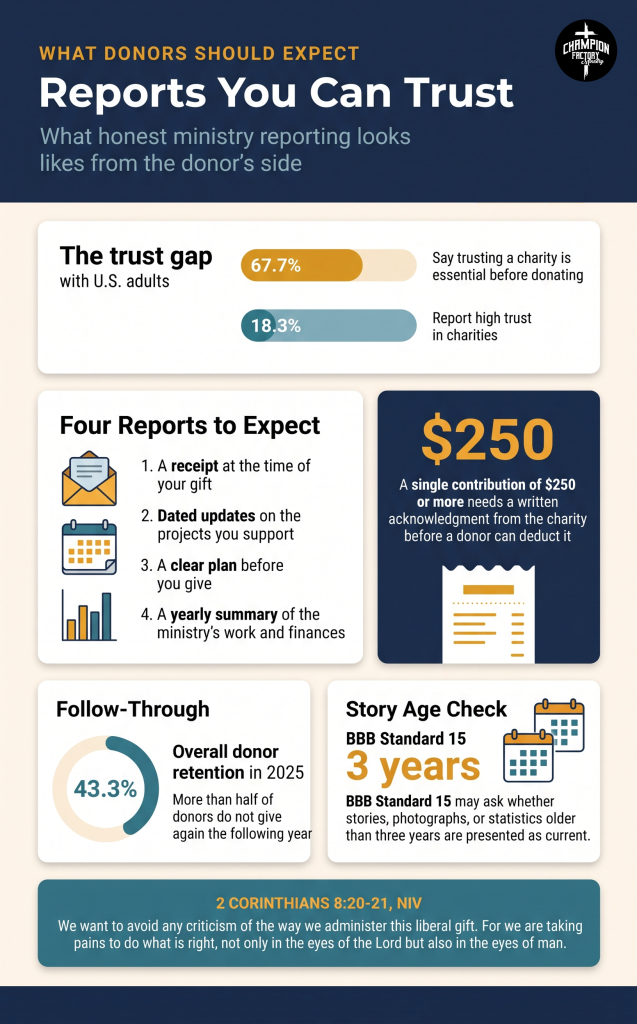
You want to know what your gift actually did. Many donors are not sure they can trust the answer. In a Give.org donor trust survey, 67.7 percent of U.S. adults said trusting a charity is essential before donating, but only 18.3 percent reported high trust in charities. Most guides on impact reporting are written for large nonprofits with software and evaluation staff, and few show what an honest ministry report looks like.
At Champion Factory Ministry, we treat reporting as part of stewardship. We report what we can verify, name setbacks along with progress, protect the people we serve, and leave the credit for lasting change with God. Here is what ministries track, how they report it, and how to recognize a report you can trust.
What Do Faith-Based Ministries Actually Track?
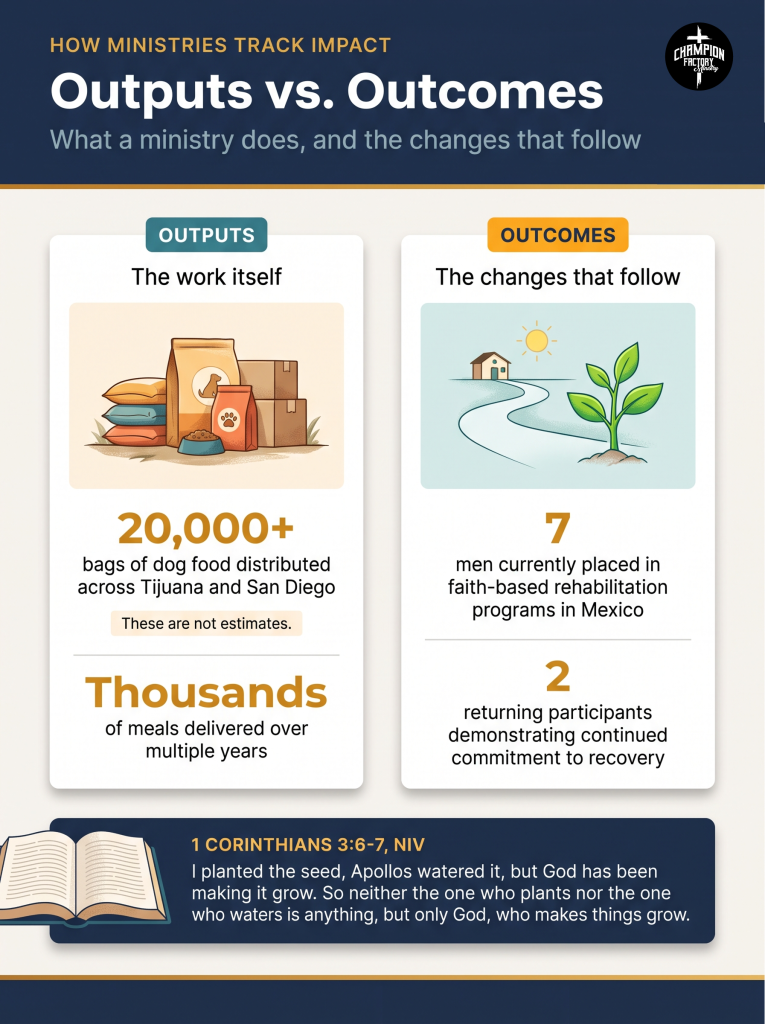
Ministries track outputs and outcomes. Outputs are the work itself, such as meals delivered, boxes shipped, or people placed in programs. Outcomes are the changes that follow, such as a family reaching stability or a person continuing in recovery. Good tracking records both, dates every count, and keeps documented numbers separate from estimates.
Outputs are easy to count. Outcomes take time, and they are shared with partners, families, and God. A good report tells you which one it is describing.
The animal outreach in Tijuana reports "More than 20,000 bags of dog food have been distributed across Tijuana and San Diego." Then it says plainly: "These are not estimates." The Mexico orphanage partnership reports "Thousands of meals delivered" over multiple years. That rounded figure stays within what the published record supports.
Why Careful Records Are a Spiritual Matter
When Paul carried a gift from the churches to believers in Jerusalem, he explained his care: "We want to avoid any criticism of the way we administer this liberal gift. For we are taking pains to do what is right, not only in the eyes of the Lord but also in the eyes of man." (2 Corinthians 8:20-21, NIV)
Accurate records serve both audiences Paul named.
What the Recovery Program Reports Today
The faith-based recovery program lists "7 men currently placed in faith-based rehabilitation programs in Mexico" and "2 returning participants demonstrating continued commitment to recovery." Partner facilities in Mexico operate the programs. The ministry identifies people who need placement, funds their participation, and walks with them through the process. The Rescue and Recovery program page explains more.
Can a Ministry Measure Spiritual Growth?
In 1 Corinthians 3:6-7, Paul says workers plant and water, but God makes things grow. A ministry can honestly report what it did and what it observed, such as a Bible study held each week or a person asking for prayer. It should not claim to count changed hearts or promise spiritual results.
Paul wrote, "I planted the seed, Apollos watered it, but God has been making it grow. So neither the one who plants nor the one who waters is anything, but only God, who makes things grow." (1 Corinthians 3:6-7, NIV) He was correcting a church divided over its leaders. His point was humility, not a ban on counting.
"We can report that we showed up and taught. What God does in a child's heart is His to report, and we leave it with Him." Todd Medina, President & Founder
Why More Testimonies Do Not Prove More Fruit
Some reports use testimonies as a stand-in for spiritual metrics. That can pressure people to share before they are ready. One honest observation, shared with consent, is worth more than a page of polished stories.
Should Ministries Tell Donors When Something Did Not Work?
If you only ever see good news, it is hard to know what is real. Ministries should report setbacks. A report that names what did not go as hoped shows the ministry is tracking honestly and gives you a true picture of the work your support makes possible.
The BBB Standards for Charity Accountability point the same way. Guidance for Standard 7 says an effectiveness report should analyze how well goals were met and recommend next steps when they were not.
Hard Outcomes the Ministry Has Published
- The recovery program page states the ministry "does not present this work as a guaranteed outcome." It reports that some men who completed their time later fell back into old patterns, and a few returned in worse condition.
- The animal outreach page notes that a few animals were lost despite the team's efforts.
- The Walking in Truth story gives an honest account of one situation where the ministry stepped back from a relationship it had invested in significantly. Its section "Why This Story Belongs in the Record" explains that partner trust requires accountability.
A return to a recovery program is part of an honest record. It is not a verdict on a person.
"When a man comes back to a program, we say so. Leaving it out would protect our image, and it would teach donors to expect a story that is not true." Todd Medina, President & Founder
How Do Ministries Share Stories Without Exposing People?
Start by reading a ministry's media or photo policy. It shows how the ministry handles consent before sharing images and stories. Strong policies require guardian consent for identifiable minors and avoid identifying details in sensitive situations. A report with fewer faces and names often reflects care for people, not a lack of results.
The ministry's media and photo policy states: "In situations involving survivors of trafficking, abuse, addiction, or other sensitive circumstances, we do not publish identifying images or personal details without explicit informed consent." It also requires parental or guardian consent before publishing any image of an identifiable minor.
Protection covers donors too. Bennett Weiner, President and CEO of BBB's Give.org, has said charities must lead with transparency, "prioritize data protection, and communicate clearly."
What Careful Storytelling Looks Like
- Share aggregate counts instead of personal details.
- Leave out faces and locations in sensitive stories.
- Avoid before and after framing for people.
- Never describe how someone was harmed.
Honoring People You Will Never Meet
You can respect the people behind a report by not asking for names or photos the ministry has chosen to protect. If you or someone you love is facing addiction, abuse, or exploitation, please contact a licensed professional or a local crisis service. A ministry report is not a substitute for that care.
What Reports Should Donors Expect to Receive?
Expect four things: a receipt at the time of your gift, dated updates on the projects you support, a clear plan before you give, and a yearly summary of the ministry's work and finances. If you gave to a specific project, you should also hear from the ministry if that project changes.
Four Reports Worth Watching For
- A receipt. The IRS requires a written acknowledgment from the charity before a donor can deduct a single contribution of $250 or more. Under its donation policy, donors with a valid email "will receive an electronic donation receipt at the time of their gift." The ministry does not provide tax advice, so consult a tax professional.
- Dated updates. The classroom cause on the outcomes page reports: "As of September 2026: both classroom containers have been cut, framed, sealed, primed, and painted, one green, one blue, and have left the fabrication yard on flatbed trucks bound for the school site." It then lists what comes next.
- A clear plan. The computer lab cause lists what a gift provides, including 10 desktops, 10 monitors, and 2 printers, so you can later compare what was delivered with what was promised.
- A yearly summary. Under BBB Standard 16, an annual report can be a simple document or web page covering the mission, the past year's program accomplishments, a board roster, and basic financial information.
What Happens When a Designated Project Changes
Designated gifts are honored with "every reasonable effort." If a designated program is discontinued, fully funded, or unable to receive the gift, the ministry "will notify you in such cases and offer you the option to redirect or receive a refund of the unspent designated amount." Current projects are listed on the causes page.
How Can a Small Ministry Report Well Without Special Software?
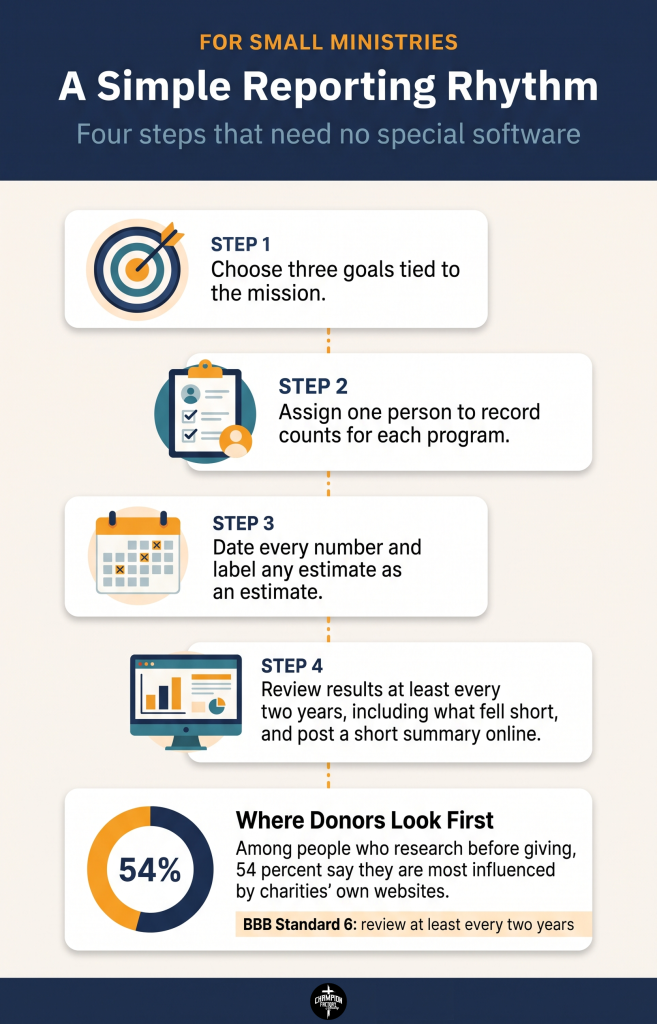
Most ministries have no evaluation staff or expensive tools. They can still report well by setting a few goals, recording counts on the same schedule, and reviewing results honestly. BBB Standard 6 calls for an effectiveness review at least every two years, and a short, dated document is enough to share what was learned.
A workable rhythm:
- Choose three goals tied to the mission.
- Assign one person to record counts for each program.
- Date every number and label any estimate as an estimate.
- Review results at least every two years, including what fell short, and post a short summary online.
That last step matters. Among people who research before giving, 54 percent say they are most influenced by charities' own websites.
"A board should ask what fell short before it asks what to celebrate. That question keeps a ministry honest long before a donor reads the report." Art Montgomery, Global Evangelism Strategy Architect & Board Visionary Luminary
Reporting Back to the People Who Send You
After their first missionary trip, Paul and Barnabas returned to the church that sent them. "On arriving there, they gathered the church together and reported all that God had done through them and how he had opened a door of faith to the Gentiles." (Acts 14:27, NIV) Their report centered on what God did.
How Church and Business Partners Can Help
Partners can ask for dated updates and share what they see on the ground. In the ministry's Philippines partnership, "Each shipment is coordinated with the missionaries on the ground so that what arrives is what is actually needed." If your organization wants to work this way, visit the partner page.
Giving With Confidence and Staying Connected
A report you can trust is specific, dated, honest about setbacks, and careful with the people it describes. It counts the work and leaves the growth to God. Before your next gift, read one impact story closely, check for a date, and look for what comes next.
To follow this work, join the Champion Factory Ministry newsletter, where "we share impact updates, stories, and projects." You can also pray for the people and partners in these reports, explore ways to get involved, or give when you are ready.
FAQ
How old can an impact story be before it is misleading?
Under BBB Standard 15, the Alliance may ask whether stories, photographs, or statistics older than three years are presented as current. Look for a date on every story.
Does every ministry file a Form 990?
No. Churches and similar houses of worship are not required to file IRS Form 990. If a ministry does not publish one, ask what it shares instead, such as an annual report.
Why does regular follow-up matter to donors?
The Fundraising Effectiveness Project found overall donor retention was 43.3 percent in 2025. More than half of donors do not give again the following year, and steady, honest updates keep supporters connected to the work.
What should I do if a report raises questions?
Ask the ministry directly. A trustworthy ministry will explain its numbers, its scope, and its setbacks. You can reach the team through the contact page.