






Most of us are not stuck because we lack information. We are stuck because we are tired, pulled in several directions, and unsure which choice honors God. A national survey by the American Psychological Association found that about a third of adults said stress sometimes made even basic decisions difficult. Among parents, the figure was 47 percent, compared with 24 percent of adults without children.
This article explains what the Bible means by wisdom, then shows how that meaning changes the decisions in front of you. You will find a plain definition, a way to sort the decisions Scripture answers from the ones it shapes, a research-backed reason to seek counsel, and a five-step practice you can use on a good day or a hard one.
What Biblical Wisdom Actually Means
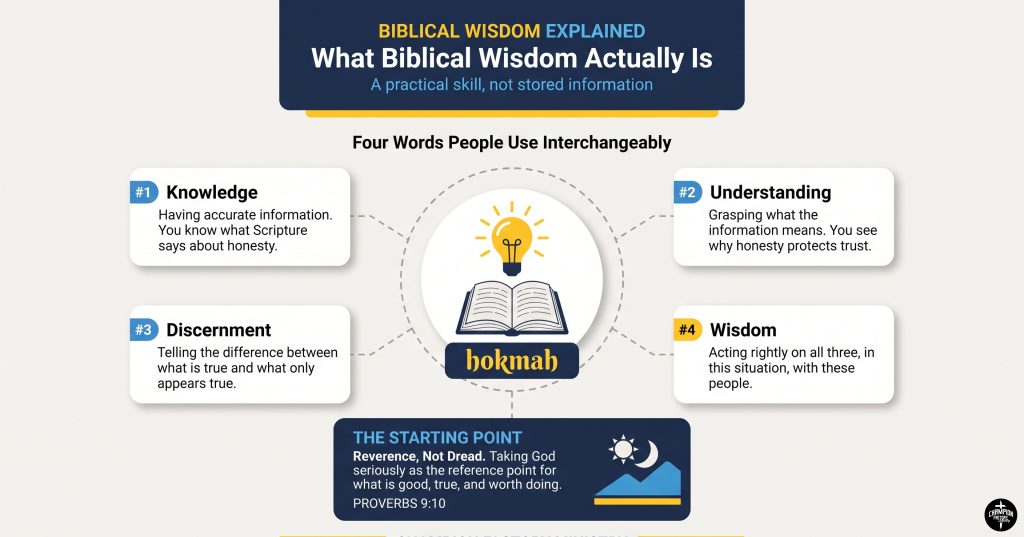
Biblical wisdom is the skill of applying God's truth to real situations. It is different from knowing a lot about the Bible. Scripture treats wisdom as practical ability, the kind of judgment that shapes how you speak, spend, work, and treat people. It begins with reverence for God and grows through practice, not through study alone.
The books most associated with wisdom in the Bible, Proverbs, Job, and Ecclesiastes, were written as instruction for living. Encyclopaedia Britannica describes the content of Proverbs as maxims about the practical, intelligent way to conduct one's life. The Hebrew word usually translated as wisdom, hokmah, covers skill as well as insight. The same word describes the craftsmen who built the tabernacle in Exodus 31. Wisdom in Scripture sits closer to skilled work than to abstract thought.
That definition removes a common barrier. You do not need a seminary degree to grow in wisdom. You need a reference point, honest input, and repetition.
Wisdom, Knowledge, Understanding, and Discernment
People use these four words interchangeably, and the confusion is part of why decisions stall.
- Knowledge is having accurate information. You know what Scripture says about honesty.
- Understanding is grasping what the information means. You see why honesty protects trust.
- Discernment is telling the difference between what is true and what only appears true. You notice when a good-sounding option carries a hidden cost.
- Wisdom is acting rightly on all three, in this situation, with these people.
James ties wisdom to action. "Do not merely listen to the word, and so deceive yourselves. Do what it says" (James 1:22, NIV).
What "The Fear of the Lord" Means in Plain Words
Scripture names the starting point directly. "The fear of the LORD is the beginning of wisdom, and knowledge of the Holy One is understanding" (Proverbs 9:10, NIV).
This phrase confuses many readers, and it is rarely explained. It does not describe living in dread of God. It describes taking God seriously as the reference point for what is good, true, and worth doing. It is the difference between asking what you can get away with and asking what is actually right.
That shift changes decisions before any specific verse comes into play. It settles who you are answering to.
Which Decisions Scripture Answers Directly and Which Ones It Shapes
Some decisions have a clear biblical answer. Do not lie. Do not take what is not yours. Do not neglect the people in your care. Most daily decisions are different. Scripture does not name your job, your city, or your budget. For those, it shapes how you decide by setting priorities, sending you to counsel, and warning you against haste.
Sorting your decision into one of these two categories takes about thirty seconds and removes a great deal of anxiety.
If Scripture speaks clearly, the work is obedience. You already know what to do, and the difficulty is doing it.
If Scripture does not speak directly, you are free to choose. That freedom feels uncomfortable, because many of us were taught to hunt for one hidden right answer and to fear missing it. A steadier approach is to ask four questions about each option. Is it honest? Is it fair to everyone involved? Can the people who depend on me sustain it? Does it match the kind of person I am becoming? Micah offers a short filter that fits nearly any decision. "To act justly and to love mercy and to walk humbly with your God" (Micah 6:8, NIV).
"When people ask us for direction, we start by separating what Scripture settles from what it leaves open. That one step takes most of the pressure off." Art Montgomery, Global Evangelism Strategy Architect and Board Visionary Luminary
Trusting God here does not mean switching off your thinking. "Trust in the LORD with all your heart, and do not lean on your own understanding. In all your ways acknowledge him, and he will make straight your paths" (Proverbs 3:5-6, ESV). The same book of Proverbs commends planning, counsel, and careful thought throughout. Trust and thinking work together.
Why You See Other People's Choices More Clearly Than Your Own
You reason more wisely about someone else's problem than about your own. Researchers have measured this. In three experiments with 693 participants, people reasoned better about a close friend's conflict than about the same conflict in their own life. The gap closed when they were prompted to view their own situation from the outside.
Proverbs said it first. "The way of fools seems right to them, but the wise listen to advice" (Proverbs 12:15, NIV). Research from the Wisdom and Culture Lab at the University of Waterloo, published in Psychological Science, puts numbers behind that verse. The same study found no meaningful difference between adults aged 20 to 40 and adults aged 60 to 80 in how wisely they reasoned about their own conflicts. Wisdom does not arrive automatically with age. It is practiced.
This is the practical case for counsel. "Without counsel plans fail, but with many advisers they succeed" (Proverbs 15:22, ESV). Advisers see the part of the situation you cannot see.
Three Ways to Get Outside Your Own View
- Describe the decision in the third person. Write out your situation using your own name, as if a friend brought it to you. Then answer it the way you would answer them.
- Ask two people who are willing to disagree with you. Look for people who know Scripture, know you, and will say something you do not want to hear. Advisers who only confirm your preference are not helping you decide.
- Name the option you are avoiding. If there is a choice you have not seriously considered, say out loud why. Sometimes the reason is wise. Sometimes it is fear.
If you do not have people like this yet, start with one. Pew Research Center found that only 13 percent of Americans take part weekly in a prayer or scripture study group, so most people are deciding alone. Building that circle is worth deliberate effort, which is why Champion Factory Ministry runs mentorship and discipleship alongside its outreach work rather than offering one-time help.
"The children and families we mentor rarely need more information. They need one steady person who tells them the truth and keeps showing up." Todd Medina, President and Founder
How Biblical Wisdom Shows Up in Ordinary Daily Decisions
Wisdom shows up mostly in small choices. How you answer a frustrating message. Whether you buy something now or wait a week. What you say when you are tired and someone needs patience. These decisions rarely feel spiritual, but they build the judgment you will rely on when a larger decision arrives.
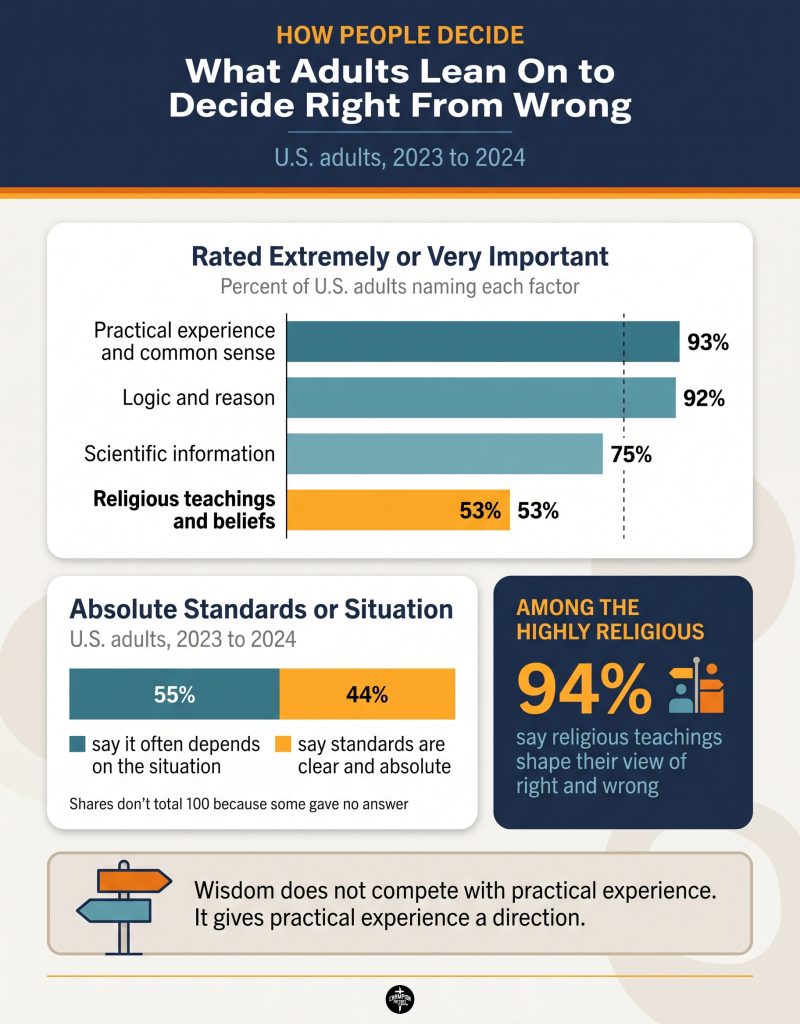
Pew Research Center found that 93 percent of U.S. adults rate practical experience and common sense as important for deciding right from wrong, while 53 percent say the same about religious teachings. Biblical wisdom does not compete with practical experience. It gives practical experience a direction.
Here is what that looks like across a normal week.
- Work: Tell the truth about a mistake early, even when covering it would be easier. Do the small task well when no one is checking.
- Money: Wait a day on anything unbudgeted. Ask whether the purchase serves the people who depend on you or only how you feel right now.
- Relationships: Ask one clarifying question before responding to something that stung. Allow that you may have misread the tone.
- Family: Choose the shorter conversation over the sharper one when you are depleted. Return to it when you have more to give.
- Online: Decide what you read rather than letting the feed decide. End a conversation that has stopped being useful.
None of these choices will feel significant on the day you make them. Together, they are the practice.
How to Make a Wise Decision on a Hard Day
When you are exhausted, grieving, or short on money, your decision-making capacity drops. Research published in Science found that prompting people with lower incomes to consider a large unexpected expense reduced their performance on reasoning tasks. Pressure uses up mental bandwidth. On days like that, the wise move is usually to make the decision smaller rather than to force it.
This is not a character problem, and Scripture does not treat it as one. Vaile Wright, a clinical psychologist with the American Psychological Association, said of stress and daily tasks that even the smallest tasks can start to feel overwhelming. The research on financial pressure, reported in Science, describes a cognitive load that pulls attention away from everything else. A published comment questioned parts of that statistical analysis, so treat the finding as strong evidence rather than a settled rule.
The strain itself is common. In 2024, the U.S. Department of Agriculture reported that 13.7 percent of American households experienced food insecurity at some point during the year, and children were affected in 9.1 percent of households with children. Decisions made under that kind of pressure deserve grace.
"We see clearer decisions after a family's immediate needs are met. Groceries do not make the choice for them. They give them room to think." Todd Medina, President and Founder
Practical steps for a hard day:
- Sort by urgency. Ask what must be decided today and what can wait until Thursday. Most things can wait.
- Reduce the decision to one next action. Not the whole plan. One call, one form, one conversation.
- Meet a physical need first. Eat something, drink water, sleep if you can. Clear thinking is partly physical.
- Borrow judgment. Hand the decision to one trusted person and ask what they see.
- Ask without shame. "If any of you lacks wisdom, you should ask God, who gives generously to all without finding fault, and it will be given to you" (James 1:5, NIV). The verse describes God's posture, not only the request.
Scripture also warns against forcing a decision under pressure. "The plans of the diligent lead to profit as surely as haste leads to poverty" (Proverbs 21:5, NIV). Waiting is often the wise choice rather than the passive one.
When to Involve a Professional
Some decisions carry stakes that prayer and counsel are not designed to carry alone. Seeking professional help is a wise decision, not a failure of faith.
- Contact a licensed counselor or your doctor for decisions involving mental health, safety, or ongoing physical symptoms.
- Contact an attorney for decisions involving custody, housing, immigration status, or legal exposure.
- Contact a qualified financial professional before decisions involving debt settlement, retirement funds, or major loans.
If you are in immediate danger, contact local emergency services or a crisis line first. Our team offers practical care, encouragement, and spiritual support. We are not a substitute for licensed counseling, medical, legal, or financial services, and we are glad to walk alongside you while you get that help.
A Five-Step Wisdom Practice You Can Use This Week
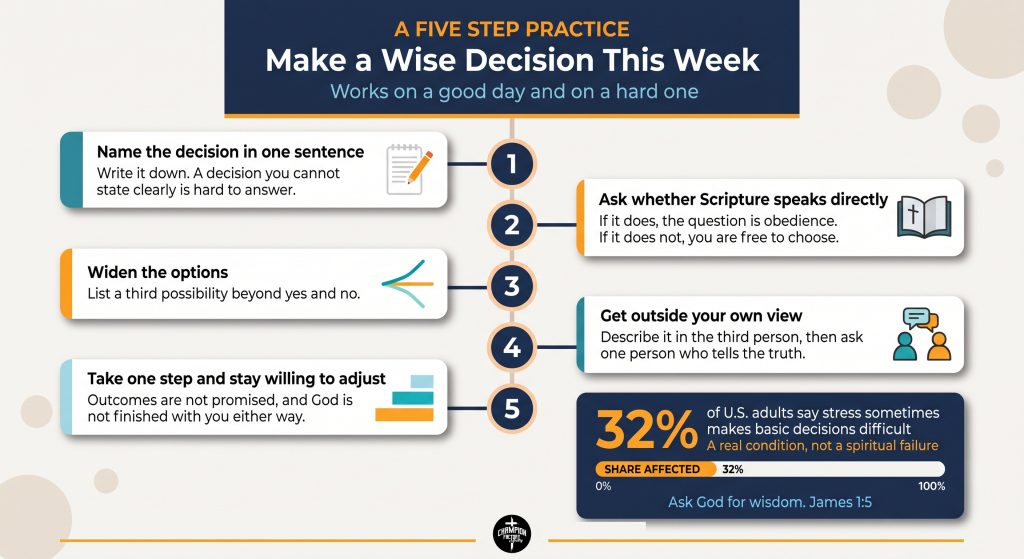
Pick one decision you are carrying right now. Then work these five steps in order. The goal is not a guaranteed outcome. The goal is to decide with a clear reference point, honest input, and enough space to think.
- Name the decision in one sentence. Write it down. A decision you cannot state clearly is hard to answer.
- Ask whether Scripture speaks directly. If it does, the question is obedience. If it does not, you are free to choose well.
- Widen the options. List a third possibility beyond yes and no.
- Get outside your own view. Describe the situation in the third person, then ask one person who will tell you the truth.
- Take one step and stay willing to adjust. Outcomes are not promised, and God is not finished with you if a choice turns out differently than you hoped.
"Wisdom is not a decision you make once. It is a habit you build in the ordinary weeks, so it is there in the difficult ones." Art Montgomery, Global Evangelism Strategy Architect and Board Visionary Luminary
Where to Take Your Next Wise Step
Biblical wisdom is not a level you reach. It is a skill you build by practicing something small today and again tomorrow. It starts with taking God seriously. It grows through people who tell you the truth. It shows up in choices that rarely feel spiritual at the time.
If you are deciding something hard right now, start with the smallest honest step. Write the decision down. Ask God for wisdom, knowing he gives it without finding fault. Then bring one person into it. If you would like that person to come from our community, you can reach out to us here. If you want to help others carry decisions like this, you can get involved as a volunteer or partner.
You do not have to decide well alone.
FAQ
What is the biblical definition of wisdom?
Biblical wisdom is the skill of applying God's truth to real situations. Scripture describes it as practical ability, closer to skilled work than to abstract knowledge, and it starts with reverence for God.
What is the difference between wisdom and knowledge in the Bible?
Knowledge is having accurate information. Wisdom is acting rightly on that information in a specific situation. A person can know a great deal and still act unwisely.
Does the Bible tell me exactly what to do in every decision?
No. Scripture speaks directly to moral questions such as honesty and how you treat people. For most everyday decisions, it shapes your priorities and your process rather than naming one outcome.
Why is it easier to advise a friend than to decide for myself?
Distance improves judgment. Research from the University of Waterloo found that people reason more wisely about others' problems than their own, and that the gap narrows when they view their own situation from the outside. Proverbs 12:15 makes a similar point about listening to advice.
How do I grow in wisdom if I am not a Bible scholar?
Start small and repeat it. Read a short passage regularly, ask God for wisdom, and bring one honest person into your decisions. Pew Research Center found that about a third of U.S. adults read scripture or devotional material at least monthly, so a modest habit already puts you in steady practice.
Is it wrong to see a counselor instead of just praying?
No. Prayer and professional care work together. For decisions involving mental health, safety, legal exposure, or major finances, involving a licensed professional is part of deciding wisely.