






Many people encounter Jehovah's Witnesses through a knock at the door, a conversation with a neighbor, or a close relationship with a family member. The people who come to those conversations are sincere. They carry their Bibles, they speak about God and Jesus, and they believe they are sharing truth. But sincere belief and biblical accuracy are not always the same thing.
This article is not written to argue or to condemn. It is written to help you understand your own beliefs more deeply, or to support someone who has recently left a JW congregation and is looking for solid ground. The goal here is clarity, compassion, and truth rooted in scripture.
A Movement With Modern Origins
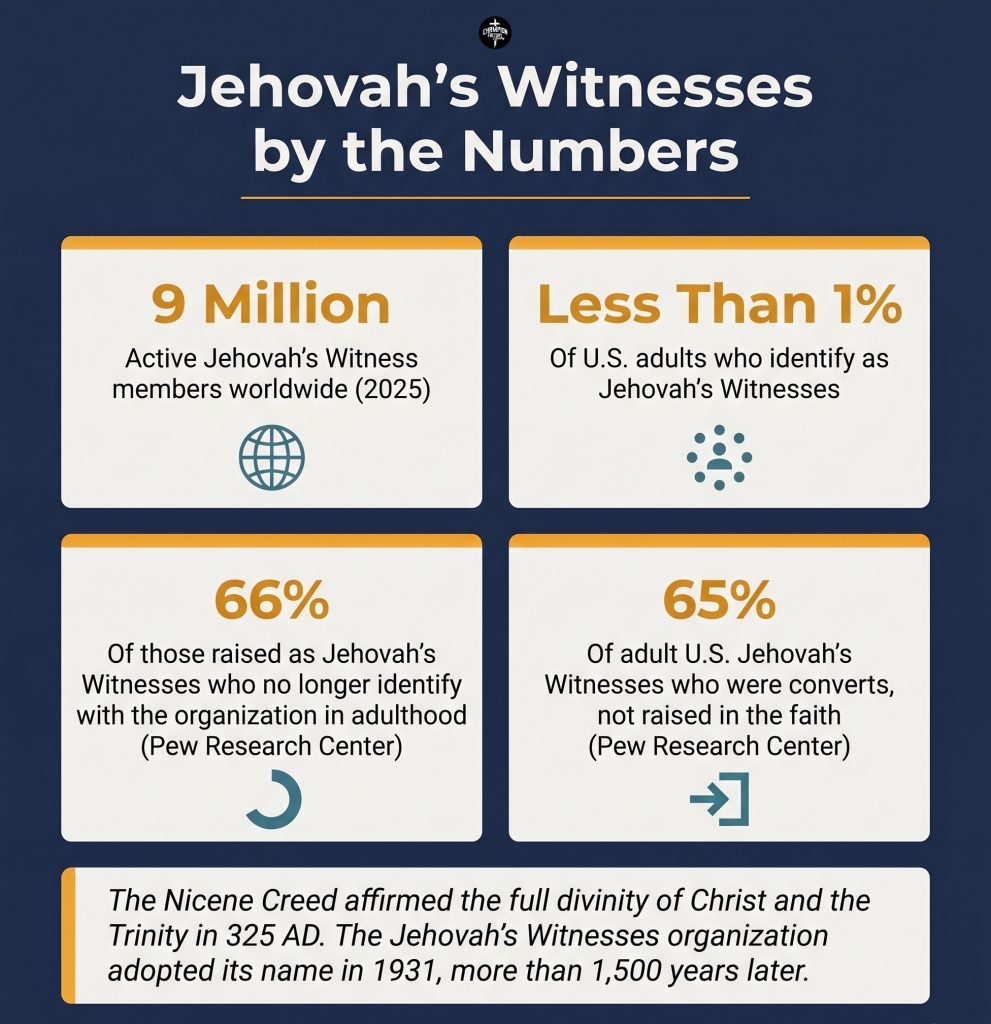
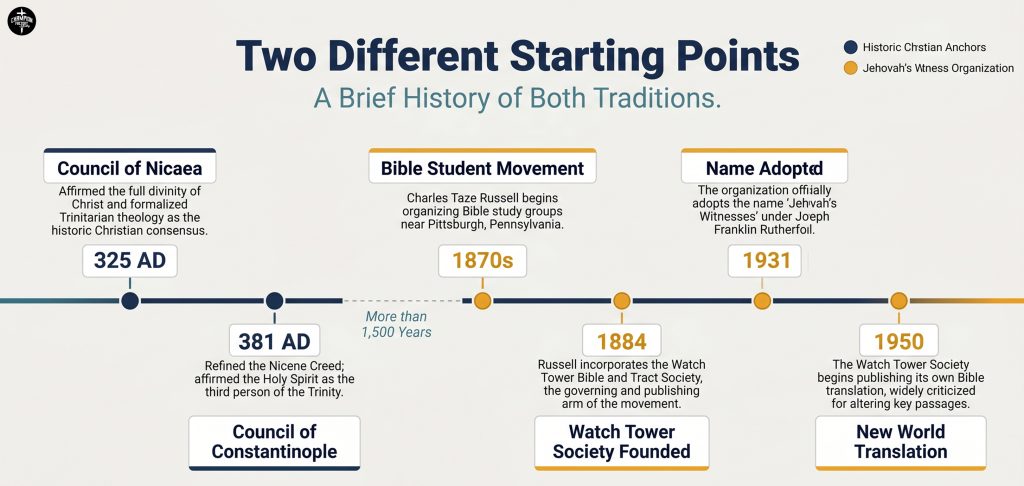
Jehovah's Witnesses emerged in the 1870s through the work of Charles Taze Russell, a Pennsylvania businessman with no formal theological training. The organization formally adopted the name Jehovah's Witnesses in 1931 under Joseph Franklin Rutherford. JW doctrine is a 19th-century development, not a recovery of early biblical faith.
Russell founded the Watch Tower Bible and Tract Society in 1884, which became the publishing and governing arm of the movement. The Watchtower, as it is commonly known, produces all official JW doctrine today and is regarded by members as God's primary channel of communication on earth.
Research from the Pew Research Center found that approximately 66 percent of people raised as Jehovah's Witnesses no longer identify with the organization in adulthood. That is a significant number of people reexamining their faith and looking for firmer ground.
Historic Christianity traces its core doctrines, including the Trinity, the full divinity of Christ, and salvation by grace, through 2,000 years of scripture and the early church councils that worked carefully through those texts. JW theology is a departure from that tradition, not a recovery of it.
The Question at the Center: Who Is Jesus Christ?
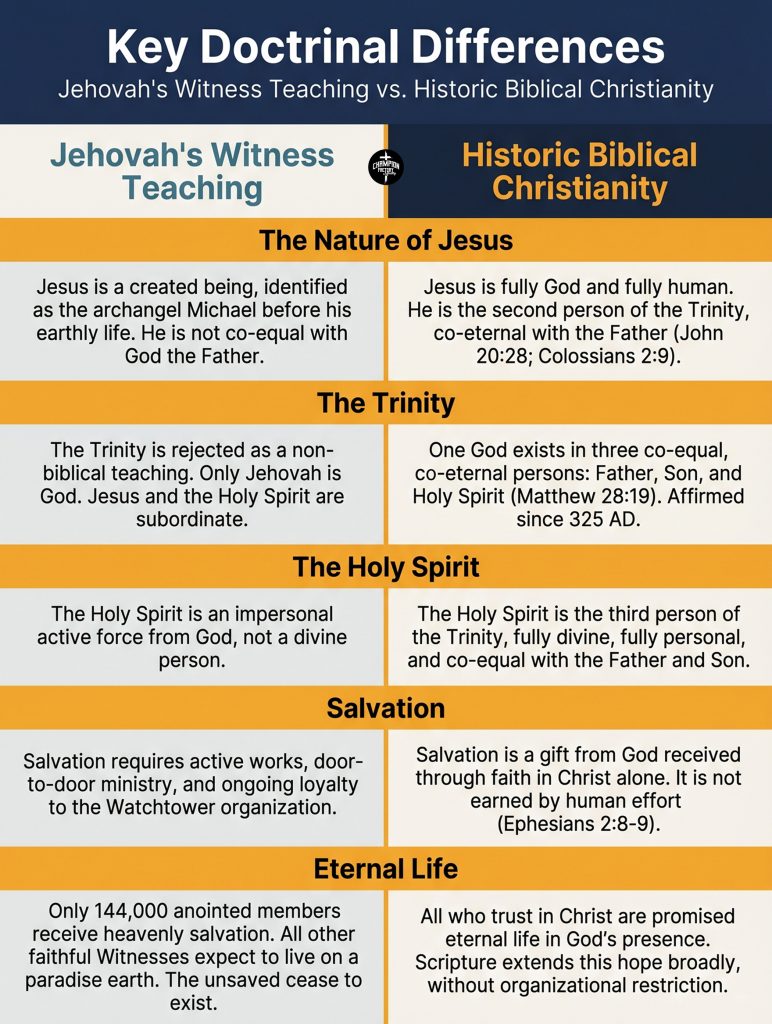
Historic Christianity teaches that Jesus is fully God and fully human, the second person of the Trinity, co-equal and co-eternal with the Father. Jehovah's Witnesses teach that Jesus is a created being and identify him as the archangel Michael before his earthly life. This difference over the person of Christ is the most significant doctrinal divide between JW belief and historic Christianity, and it shapes every other point of comparison.
The apostle Thomas made a direct statement in John 20:28 (NIV): "My Lord and my God!" He said this to the risen Jesus, and Jesus did not correct him. Paul wrote in Colossians 2:9 (NIV): "For in Christ all the fullness of the Deity lives in bodily form." Not a portion of deity. All of it.
John 1:1 is another key text. In the ESV it reads: "In the beginning was the Word, and the Word was with God, and the Word was God." The JW Bible renders it as "the Word was a god," inserting an article not present in the original Greek text. Dr. J. R. Mantey, a New Testament Greek scholar whose grammar was actually cited by the Watchtower Society to support this reading, publicly rejected that use. He stated that it is "neither scholarly nor reasonable to translate John 1:1 'The Word was a god.'"
"In our evangelism work, we regularly meet people who have spent years with a Bible in hand but were never given the space to question what they were being taught. Helping someone see what the text actually says, rather than what they were told it says, is some of the most important work we do." Art Montgomery, Global Evangelism Strategy Architect, Champion Factory Ministry
Historic Christianity has affirmed the full divinity of Christ since the early church. In 325 AD, the Council of Nicaea formalized what the church had believed from the beginning: that the Son is fully God, not a lesser or created being. A similar theological position, called Arianism, was examined at Nicaea and rejected because it conflicted with what scripture actually teaches.
The Holy Spirit: Person or Force?
JWs teach that the Holy Spirit is not a person but an impersonal active force from God. Historic Christianity holds that the Holy Spirit is the third person of the Trinity, fully divine and fully personal. Jesus himself used a Trinitarian formula in Matthew 28:19 (NIV), commanding believers to baptize "in the name of the Father and of the Son and of the Holy Spirit." All three share one name. That is not the language of one God and two lesser beings. It is the language of three persons sharing one divine nature, which is what the Nicene Creed has articulated since 381 AD.
A Different Bible for Different Doctrine
The New World Translation, published by the Watch Tower Bible and Tract Society beginning in 1950, is the Bible used exclusively by Jehovah's Witnesses. Biblical scholars across many backgrounds have criticized this translation for altering key passages, particularly those that address the deity of Christ, to fit JW theological positions rather than to faithfully represent the original Greek and Hebrew texts.
Dr. Anthony A. Hoekema, Professor of Systematic Theology at Calvin Theological Seminary, described the NWT as "a biased translation in which many of the peculiar teachings of the Watchtower Society are smuggled into the text of the Bible itself."
This matters because it shapes how JW members read foundational passages. The Bereans in Acts 17:11 (NIV) were commended because "they received the message with great eagerness and examined the Scriptures every day to see if what Paul said was true." The standard is scripture itself, not the interpretation of a single organization. That principle applies to every tradition, including your own.
How Salvation Is Understood Differently
Historic Christianity teaches that salvation is a gift from God received through faith in Jesus Christ. It cannot be earned through human effort or secured through membership in a religious organization. JW teaching adds conditions to this, requiring active participation in Watchtower programs, door-to-door ministry, and ongoing organizational loyalty as requirements for standing with God. These are two different understandings of what saves a person.
Paul addresses this directly in Ephesians 2:8-9 (ESV): "For by grace you have been saved through faith. And this is not your own doing; it is the gift of God, not a result of works, so that no one may boast."
JW doctrine also limits the hope of heavenly salvation to 144,000 "anointed" members. The remainder of faithful JWs are taught to expect a paradise earth rather than eternal life in God's presence. Historic Christianity holds that the promise of eternal life with God is extended to all who trust in Christ, not to a fixed number of the specially designated. The Christian Research Institute has noted that JW teaching fundamentally denies salvation by grace through faith alone and replaces it with a works-based system tied to the organization itself.
Different Views on Eternity
JW teaching holds that unsaved individuals simply cease to exist after death rather than face conscious existence beyond it. Most of historic Christianity, across Catholic, Orthodox, and Protestant traditions, has understood scripture to teach that all people continue to exist after death and that their eternal destination is shaped by their relationship with God through Christ. This is a meaningful point of difference between the two traditions.
The precise nature of eternal judgment does involve some theological discussion within the broader Christian community, and this article does not aim to settle every aspect of that conversation. What historic Christianity does affirm without wavering is that those who trust in Christ are promised eternal life in his presence. Scripture extends that hope broadly and without organizational restriction.
What This Means for You and How to Move Forward
Understanding these differences is not an invitation to argue. It is an invitation to know your own faith more deeply, to speak with clarity and kindness when the conversation comes, and to extend genuine grace to the people you encounter. Many people who leave JW congregations carry real pain. Rebuilding faith after a controlling religious environment takes time, community, and care.
If you have a JW family member or neighbor, the most meaningful thing you can offer is not a well-prepared debate. It is a consistent, steady example of grace in action. Historic Christianity is more than a list of correct doctrines. It is a relationship with a God who came close in Jesus Christ, who offers salvation as a gift, and who calls his people to love one another faithfully.
"We meet people from many different backgrounds. Some have left religious settings where they were told what to believe without the freedom to question or examine it. Our aim is to offer them a faith rooted in grace, not performance." Todd Medina, President and Founder, Champion Factory Ministry
If you are personally rebuilding your faith after leaving a JW congregation, you are not alone in that process. The disorientation of reexamining what you believe and the grief of relational loss are real. Pastoral support and professional counseling are both worth pursuing alongside one another. Champion Factory Ministry's Nourish discipleship program walks alongside people who are seeking to grow in faith, find grounded biblical community, and move toward stability and restored hope. You can learn more about how to get involved or connect with our care team.
Historic Christianity rests on a gift freely given in Christ, not a performance carefully maintained. That is worth taking seriously.
FAQ
Are Jehovah's Witnesses Considered Christians?
Jehovah's Witnesses identify as Christians. Most of historic Christianity, including Catholic, Orthodox, and Protestant traditions, does not consider JW theology to fall within orthodox Christianity because it denies the Trinity, the full divinity of Christ, and salvation by grace through faith alone.
What Is the New World Translation?
The New World Translation is the Bible produced by the Watch Tower Bible and Tract Society and used exclusively by Jehovah's Witnesses. First published in 1950, it has been criticized by biblical scholars for altering key passages, particularly on the nature of Christ, to align with JW theological positions rather than with the original Greek and Hebrew texts.
What Is the Nicene Creed and Why Does It Matter Here?
The Nicene Creed is a statement of Christian belief established at the Council of Nicaea in 325 AD and refined at Constantinople in 381 AD. It affirms the Trinity, the full divinity of Christ, and the personhood of the Holy Spirit. It represents the historic consensus of the early church and is shared across Catholic, Orthodox, and Protestant traditions today. JW doctrine departs from the Nicene Creed at several key points.
What Should I Do If a Family Member Is a Jehovah's Witness?
Approach the relationship with patience and genuine love. Understanding the doctrinal differences helps you speak with confidence, but the most meaningful thing you can offer is a consistent example of grace. Avoid argument for its own sake. Ask questions. Listen well. If the relationship brings grief or confusion, pastoral support is available to help you work through it.