




On a rainy Saturday in Mexico, eight families stood in the street with nothing left. A fire had destroyed their homes. A team from the ministry responded with immediate supplies and coordinated recovery support for the individual at the center of the crisis. Four months later, both the community and that man were rebuilding.
That story is representative, not exceptional. This article shares three real situations from the field, explains what they reveal about genuine community transformation, and shows why honest, sustained care produces outcomes that broader claims and polished programs rarely do.
What Community Transformation Actually Looks Like
Community transformation is not a single event. It is the result of consistent presence, practical care, and relationships built over months and years. It looks like families finding stability, individuals choosing a different path, and communities that once needed outside help beginning to strengthen those around them. The signs are specific and documented.
Most people carry a general sense that faith-based nonprofits do good work. What they often lack is a clear picture of what that work actually produces. Transformation rarely arrives on a fixed timeline or in one dramatic moment. It tends to happen across a series of decisions, relationships, and responses, some visible and some not.
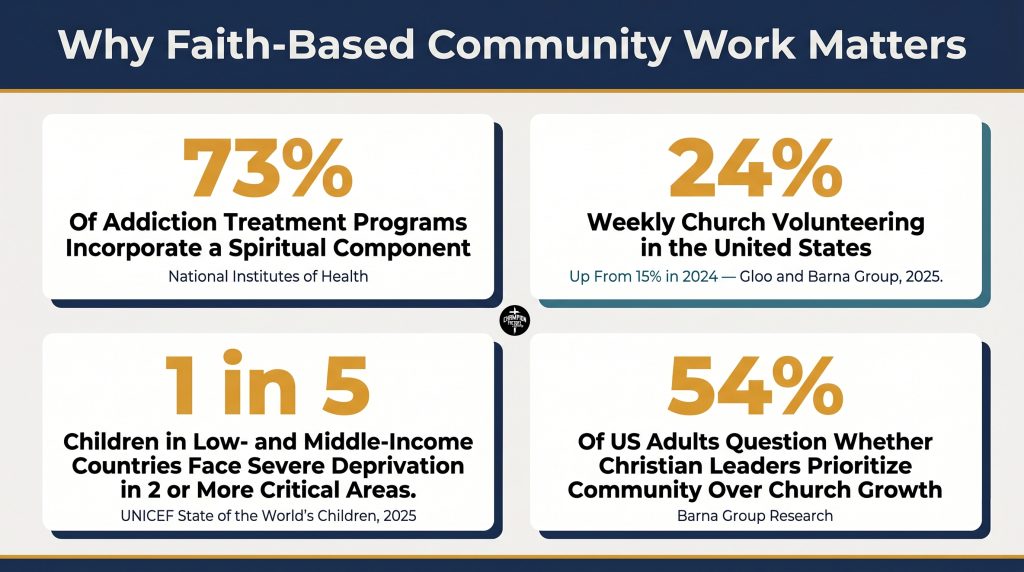
Research from Gloo and Barna Group found that early 2025 data showed weekly church volunteering in the United States rising to an estimated 24 percent, up from 15 percent in 2024. More people are choosing to serve their communities. What sustains that engagement, beyond initial enthusiasm, is evidence that the work actually matters. Real, specific stories are that evidence.
"When people ask what transformation looks like, I point them to the stories," said Robert Crouse, Community Liaison. "Not programs on paper. Specific situations, specific people, specific outcomes."
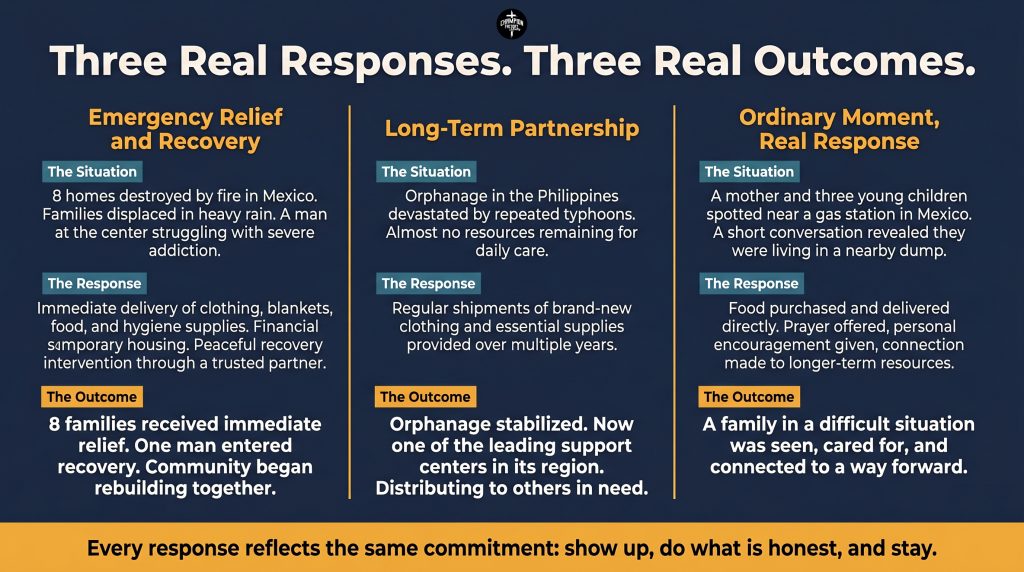
When Immediate Relief and Recovery Happen at the Same Time
The most effective ministry responses address more than one need at once. When eight families lost their homes to a fire in Mexico, the team did not choose between emergency relief and recovery support. They pursued both. Four months later, the displaced families had received care and the individual at the center of the crisis had chosen recovery.
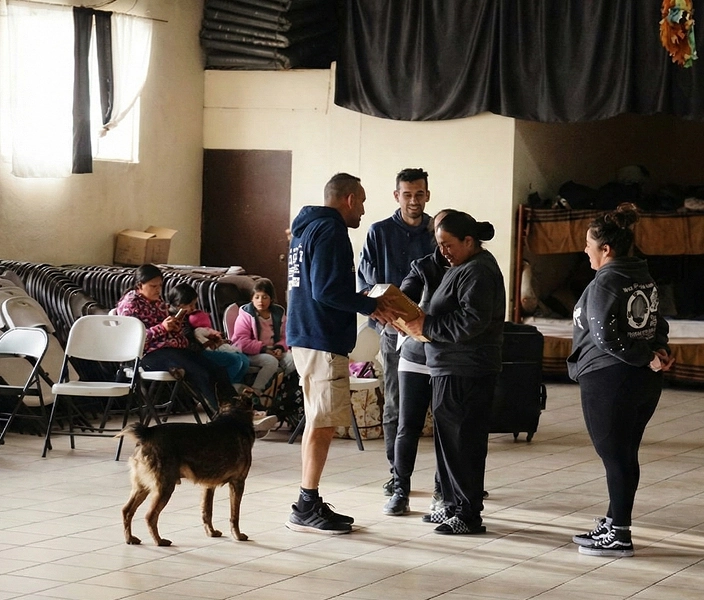
The fire spread fast through homes built from lightweight materials. By the time it was out, eight families had lost everything. Rain was already falling. Children had no dry shelter, no clothing, and no immediate place to stay.
The team moved quickly. They organized and delivered truckloads of clothing, blankets, food, and essential hygiene supplies. Financial support went toward temporary housing to keep families safe through the days of heavy rain that followed.
At the same time, the team recognized that the crisis had a deeper source. A man struggling with severe addiction had been at the center of events. Rather than responding with judgment or pressure, the ministry reached out through a trusted rehabilitation partner and coordinated a peaceful intervention.
"You cannot force someone to change," said Todd Medina, who helped coordinate the response. "But you can show up without judgment and give them a door to walk through. That is what we tried to do."
He walked through it. Four months into recovery, people who knew him described him as calm, clear-minded, and working toward a new start. The community that had once lived with fear of his instability was watching his recovery with something closer to hope.
"In these communities, trust is built slowly," said Patty Villa, Mexico Community Outreach and Educational Intervention Director. "When we show up consistently and treat people with dignity, things start to shift. That is true in a crisis and it is true in the ordinary moments between crises."
Research published through the National Institutes of Health found that 73 percent of addiction treatment programs in the United States incorporate a spiritual component. Faith is not separate from effective support. In this situation, it was present in every step of how the team responded.
You can read the full account in the From Ashes to Restoration impact story.
What Years of Consistent Support Produce
A one-time donation helps for a day. Sustained, reliable support changes what an organization becomes over time. One orphanage in the Philippines, left with almost no resources after a series of devastating typhoons, received consistent shipments of clothing and essential supplies over multiple years. Today, that same orphanage distributes shoes and resources to other families in need and operates as one of the leading support centers in its region.
When the ministry first connected with this orphanage, the situation was critical. The storms had stripped the facility of almost everything. Staff were working to keep children fed, clothed, and safe one day at a time, with very little margin for anything beyond survival.
The team began sending regular shipments of brand-new clothing and essential supplies. Each delivery addressed an immediate need. Taken together over time, they gave the facility a foundation of stability to build from.
"When you are not spending every day scrambling for basics, you can start thinking about what comes next," said Robert Medina, who has worked directly with the ministry's Philippine partners. "That is what consistent support creates. It creates space for growth."
That growth became visible. The orphanage's situation stabilized. Its reputation in the region grew. Other families and organizations began looking to it as a resource. The orphanage that had once struggled to keep shoes on the children's feet began distributing shoes to others.
"Building a real partnership takes more than a single delivery," said Robert Crouse, Community Liaison. "It requires showing up over time, following through, and being honest about what you can and cannot do. That is how an organization in crisis becomes an organization that helps others out of crisis."
UNICEF's 2025 State of the World's Children report found that 1 in 5 children in low- and middle-income countries face severe deprivation in at least two critical areas, including housing, nutrition, and education. What this orphanage is now doing for other families in its region speaks directly into that need.
Galatians 6:9 (ESV) speaks directly to this kind of work: "And let us not grow weary of doing good, for in due season we will reap, if we do not give up."
The full story is documented in the Philippines orphanage impact story.

Why Showing Up in Ordinary Moments Still Matters
Not every ministry moment begins with a structured program or a planned response. Sometimes it begins with a gas station stop. When a field team noticed a mother and three young children standing outside a gas station during a routine stop in Mexico, a short conversation revealed the family was living in a nearby dump. The team bought food, followed the family home, and responded with care and clear-eyed judgment about what was appropriate.
What they found was a difficult situation. The conditions were severe. There were signs of deeper instability present. The team contacted a trusted ministry associate to help assess what kind of support was appropriate and safe to offer.
They provided food directly to the family. They prayed with them, offered personal encouragement, and connected the family to information about resources that could provide longer-term support. They were also honest, with themselves and with each other, about the limits of what a single encounter could accomplish.
"We planted a seed," said Robert Medina. "We cannot always be the ones who walk a person all the way through. But we can make sure they know they are seen, that someone cares, and that there is a way forward if they choose to take it."
This story does not have a fully resolved ending. The family's situation remained complex. If you or someone you know is facing a crisis situation, professional counselors and community support resources are available and should be sought out. Faith-based care works alongside professional support, not in place of it.
What the encounter produced was real. A mother and her children knew, for a moment, that someone had stopped. Someone had noticed. Someone had cared enough to follow them home and treat them with dignity. That is not a small thing, even when the full picture remains open.
The full account is in the Divine Encounter impact story.
How Faith Shapes the Way the Work Gets Done
Faith-centered ministry is not distinguished by its belief statements alone. It is distinguished by how those beliefs shape behavior in the field. Dignity, non-judgment, and long-term commitment are not values held in principle only. They show up in documented field decisions, including when to intervene, how to intervene, and how to acknowledge limits honestly without abandoning the person in front of you.
Barna Group research found that 54 percent of US adults agree at least somewhat that Christian leaders focus on growing their own organizations rather than on community transformation. That perception reflects a real gap between what faith organizations say and what they visibly do. The three stories in this article sit directly against that gap. They are not testimonies about programs. They are accounts of specific decisions made by specific people in complex moments.
Isaiah 58:6-7 calls the church toward practical, person-centered care for the hungry, the unhoused, and those who are bound. The field responses documented in this article reflect that kind of ministry in practice, not as a program statement, but as a pattern of documented action over years.
The rescue and recovery, outreach, and children and families programs all reflect the same values visible in these stories.
Stories Like These Are How You Know the Work Is Real
Transformation is easy to claim. It is harder to document. The three situations in this article are documented. The outcomes are specific. The people involved are real, even when their names and details are protected to preserve dignity and safety.
An orphanage that now serves others. Eight families who received relief when the rain started falling. A man four months into recovery. A mother and her children who were seen and cared for on a hard day.
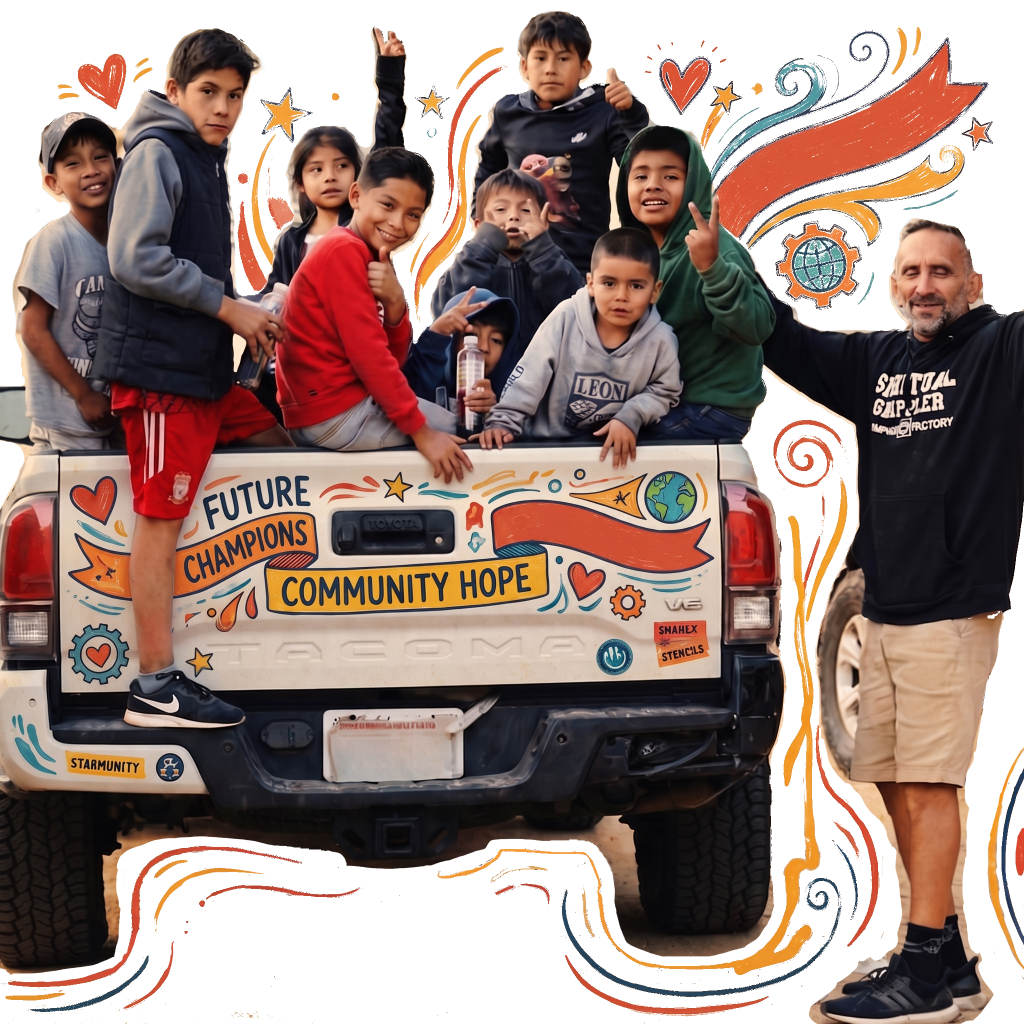
These are not isolated moments. They represent what Champion Factory Ministry does across Mexico, the Philippines, and beyond. The consistency behind those outcomes is funded by donors, sustained by volunteers, and made possible by partners who choose to invest in an organization that shows up, tells the truth, and stays.
If you are ready to be part of that, you can give today, get involved, or partner with the ministry in ways that fit your capacity and calling.
FAQ
What Is Community Transformation in the Context of Christian Ministry?
Community transformation is the measurable, lasting change that results from sustained, faith-centered care. It is not a single program or event. It is what happens when an organization consistently meets practical needs, builds relationships, and supports people toward stability over time. The stories in this article are concrete examples of what that looks like in documented field situations.
How Does the Ministry Approach Complex Situations Involving Addiction or Crisis?
The ministry approaches these situations with non-judgment, patience, and collaboration with trusted rehabilitation and community partners. It does not coerce or pressure individuals. It offers support, connection to appropriate resources, and consistent presence that creates space for a person to choose a different path. Professional support is always encouraged alongside ministry care for serious situations.
Does Consistent Financial Support Actually Make a Long-Term Difference?
Yes, and the Philippines orphanage story is a direct example. Years of consistent clothing and supply shipments gave a facility the stability it needed to move from surviving to serving others in its region. One-time giving helps in the short term. Sustained giving changes what an organization is capable of becoming.
How Can I Support This Kind of Work?
You can donate, volunteer, or partner with the ministry. Each path funds the relationships, presence, and field capacity that make stories like these possible. Visit the get involved page or give directly to take a next step.