





If you run a business, you may want to support a ministry but not know what a partnership involves beyond a check. You are right to ask where a gift goes and what to expect in return.
Champion Factory Ministry sees partnership as shared, long-term work. Business resources matter most when they meet trusted relationships on the ground and both sides keep showing up with a clear plan. This article covers the ministry's own partner terms, two long-running examples, current giving data, the rules on matching gifts and sponsor thanks, and questions to ask before you commit.
What Can a Business Give a Ministry Besides Money?
A business can give funding, sponsor a specific program, send employees to volunteer, or work alongside a ministry at events and outreach. Time and goods can suit a small company better than a large check. The right mix depends on what the company has and what the ministry needs, and both sides shape it together.
Jennifer Sirangelo, who led the National 4-H Council for nine years, writes that corporate partnerships add ideas, expertise, and visibility beyond funding. The most successful ones, she says, are made stronger through the "less measurable benefits of working together."
The ministry's Partner With Us page says it partners with "businesses, churches, nonprofit organizations, and community groups." It also says partnerships can be customized: "We work with each partner to identify initiatives and opportunities that align with shared goals and values."
"Tell us what your company can give, whether that is people, goods, or funds. We start from what you have and match it to a real need." Todd Medina, President & Founder
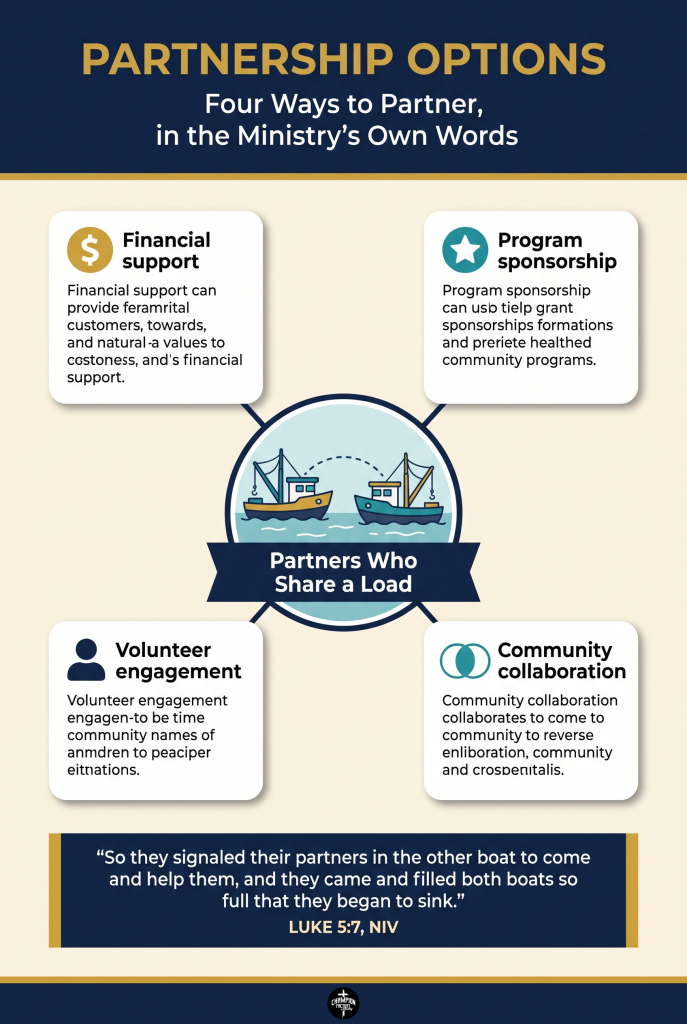
Four Ways to Partner, in the Ministry's Own Words
The page lists four options:
- Financial support: "Help fund programs, outreach efforts, and initiatives that serve children, families, and individuals in need."
- Program sponsorship: "Support specific initiatives such as mentorship, outreach events, recovery support, or discipleship programs."
- Volunteer engagement: "Encourage employees or members to serve through volunteer opportunities that strengthen communities."
- Community collaboration: "Work alongside us in events, outreach initiatives, and programs that provide practical care and encouragement."
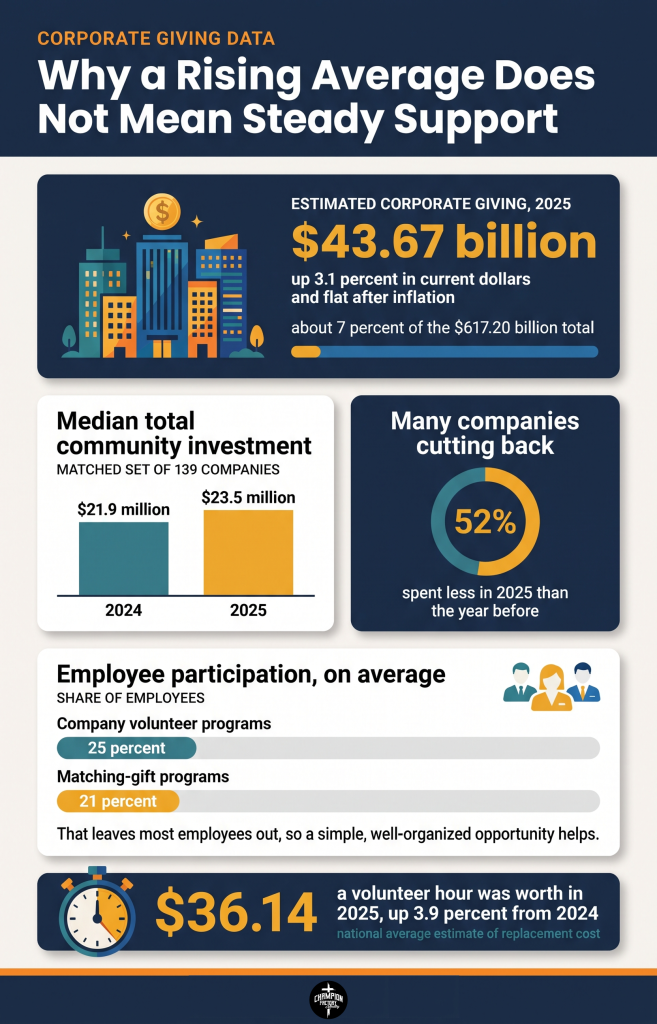
Employee time has a measurable value. Independent Sector estimates that a volunteer hour was worth $36.14 in 2025, up 3.9 percent from 2024. That is a national average estimate of replacement cost, and state figures differ.
Volunteer programs also take planning. CECP reports that on average, 25 percent of employees take part in company volunteer programs and 21 percent take part in matching-gift programs. That leaves most employees out, so a simple, well-organized opportunity helps.
Goods count too. The ministry's donation policy says it accepts in-kind gifts of "clothing, food, hygiene supplies, and other items," subject to current program needs and its capacity to receive and distribute them. Contact the ministry before you ship or deliver anything.
Giving That Ends in Thanks
Paul wrote to the church in Corinth about their gift for believers in need.
"You will be enriched in every way so that you can be generous on every occasion, and through us your generosity will result in thanksgiving to God. This service that you perform is not only supplying the needs of the Lord's people but is also overflowing in many expressions of thanks to God." (2 Corinthians 9:11-12, NIV)
The application stays modest. A gift that meets a real need can lead to thanks to God. It is not a promise of return for the giver.
Does a Long-Term Partnership Do More Than One Large Gift?
If you are choosing between one large gift and ongoing support, ongoing support gives a ministry something a single gift cannot: a supply it can plan around. The ministry's own examples show what that looks like over years, and neither story names a corporate sponsor.
Regular Shipments to Orphanage Missions in the Philippines
In the Shipping Hope story, the ministry says it "has formally adopted several orphanage missions in the Philippines, building ongoing partnerships with trusted missionaries." The supply is meant to arrive "Not as a one-time contribution but as a consistent, reliable supply line that the missionaries can count on." Each shipment "is coordinated with the missionaries on the ground so that what arrives is what is actually needed."
The ministry also states its scope: "Champion Factory Ministry does not operate these orphanages. It supports the people who do."
A second story, Building Bridges of Hope, describes a long relationship with an orphanage in Mexico that began with a practical need. The page says "Thousands of meals have been delivered to the orphanage through Champion Factory Ministry's ongoing outreach, supported by donors and volunteers who give regularly." It adds that the ministry has provided "diapers, nutritional supplements including Ensure and protein products, and other essential care items."
"Over time, a partnership becomes a relationship. The missionaries know who they can call, and we know their needs better with every shipment." Todd Medina, President & Founder
Partners Who Share a Load Too Big for One Crew
"So they signaled their partners in the other boat to come and help them, and they came and filled both boats so full that they began to sink." (Luke 5:7, NIV)
Simon Peter's boat had caught more fish than his crew could haul. In verse 10, Luke names James and John, the sons of Zebedee, as Simon's partners. The passage tells of a catch and a call. It does show partners sharing a load too large for one crew.
Why a Rising Average Does Not Mean Steady Support
Giving USA reports that corporations gave an estimated $43.67 billion in 2025, up 3.1 percent in current dollars and flat after inflation. Candid's analysis of the report puts that at about 7 percent of the $617.20 billion total.
CECP found that across a matched set of 139 companies, median total community investment rose from $21.9 million in 2024 to $23.5 million in 2025. Even so, "52% of companies spent less in 2025 than the year before." A rising median can sit alongside many companies cutting back. That makes steady, relationship-based partnerships worth planning for.
How Should a Partnership Be Set Up So Gifts Go Where Everyone Agreed?
1 Peter 4:10 describes believers as stewards, people who use what they have received faithfully. In a partnership, that starts with a clear plan. Both sides agree on goals up front, and funds go to the programs agreed on together. A ministry should be able to explain that plan in plain words before any gift arrives.
"Each of you should use whatever gift you have received to serve others, as faithful stewards of God's grace in its various forms." (1 Peter 4:10, NIV)
Peter wrote to believers about using their gifts to serve one another. Applied to a partnership, that means handling what has been entrusted with care.
In The Chronicle of Philanthropy, Sarah Thompson, acting head of corporate partnerships at Save the Children, says, "We are not the lesser partner." A good plan treats each side as a partner with real strengths.
The ministry describes its own approach on the partner page: "Partnership support is directed based on the initiatives and programs agreed upon together. We work with each partner to align funding with shared goals, establish a clear plan, and steward resources responsibly according to that agreement."
"A written agreement lets a board see what was promised and check that it was kept. That protects the partner and the people the gift is meant to serve." Art Montgomery, Global Evangelism Strategy Architect & Board Visionary Luminary
What the Donation Policy Says About Designated Gifts
The donation policy answers a common question about gifts meant for one program. When you designate a gift for a specific program or initiative, it says, "we will make every reasonable effort to honor that designation."
If a designated program is discontinued or fully funded, the policy says the ministry will notify the donor and "offer you the option to redirect or receive a refund of the unspent designated amount." That is a commitment to try, not a guarantee, so put your agreement in writing.
Five Questions to Ask Any Ministry Before You Partner
- Which specific program or initiative will our support go to?
- Where is the plan written down, and who agreed to it?
- What happens to our designated gift if that program is fully funded or ends?
- How and how often will we hear back on what our support did?
- What will our volunteers actually do on the day they serve?
Will an Employer's Matching Program Cover a Gift to a Ministry?
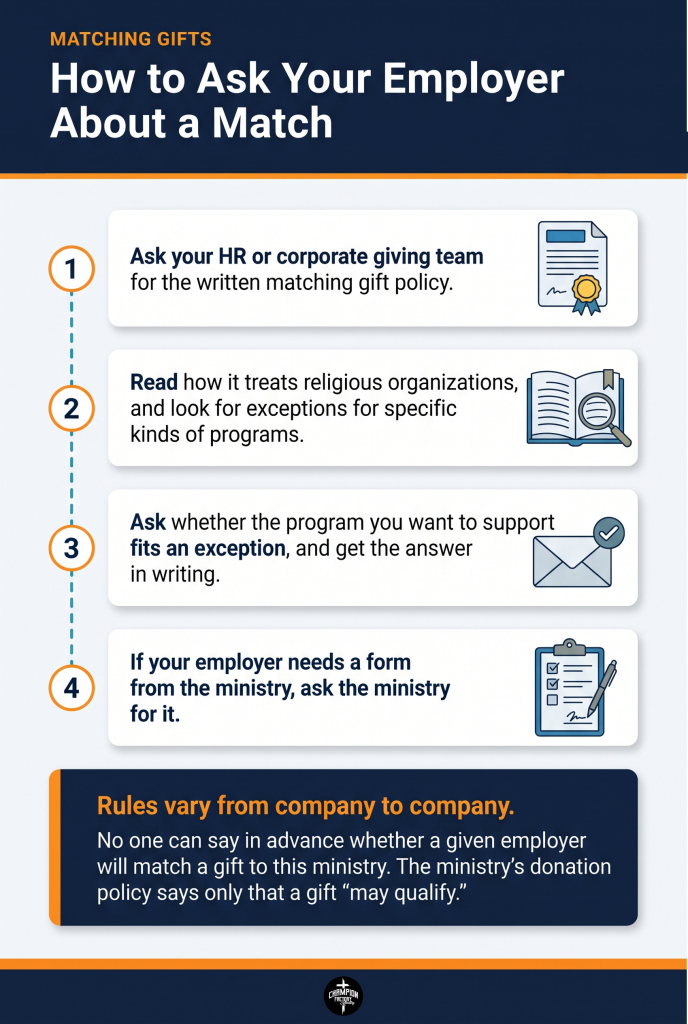
Start by reading your employer's matching gift policy and checking how it treats religious organizations. Rules vary from company to company. In general, companies do not match gifts to houses of worship, and some limit what they match at other religious organizations. A gift may qualify at one employer and not at another.
Why Eligibility Is Not All or Nothing
One large employer's published guidelines treat an organization with a stated mission to teach religious faith as ineligible. They make exceptions for certain programs, such as meals for the hungry, that serve people of any faith without proselytizing. A matching gift software company says much the same about houses of worship: in general, companies do not match gifts to them.
So two assumptions are both wrong. A ministry is not always excluded, and it is not always eligible. No one can say in advance whether a given employer will match a gift to this ministry. The ministry's donation policy says only that a gift "may qualify."
How to Ask Your Employer About a Match
- Ask your HR or corporate giving team for the written matching gift policy.
- Read how it treats religious organizations, and look for exceptions for specific kinds of programs.
- Ask whether the program you want to support fits an exception, and get the answer in writing.
- If your employer needs a form from the ministry, ask the ministry for it.
How Can a Ministry Thank a Partner Without Turning a Gift Into Advertising?
If your company gives to a ministry, you will want thanks that looks right, and the ministry will want to thank you well. The IRS treats acknowledgment and advertising differently. A ministry can thank a partner by name or logo. A message that promotes what the partner sells counts as advertising. Agree on the wording early.
The IRS guidance describes acknowledgments as "the mere recognition of sponsorship payments." A sponsor's logo or name alone counts as acknowledgment. A message that mixes advertising with acknowledgment is treated as advertising. Minor benefits worth no more than 2 percent of the payment are disregarded. In this article, thanks means acknowledgment, not promotion.
"Thanks should name the gift and the work it supported. It should never read like a sales message." Art Montgomery, Global Evangelism Strategy Architect & Board Visionary Luminary
Three Ways to Keep Thanks Simple
- Name the partner and, if the partner agrees, show its logo.
- Describe what the partner supported in plain, factual words.
- Leave out claims about the partner's products, prices, or quality.
When to Bring In a Tax Professional
Deductions, sponsorship rules, and the value of in-kind gifts are tax questions. This article is general information, not tax or legal advice. The ministry's donation policy says it "does not provide tax advice" and it does not provide formal appraisals for in-kind gifts. A tax professional can help your company sort those out.
A Plain Next Step for Businesses Weighing a Ministry Partnership
A corporate partnership works best for a ministry when it is planned, steady, and written down. Start with one conversation. Name what your company can give, ask which current need it fits, and request the plan in writing before any gift or shipment arrives.
Bring the questions from this article. The causes page lists current needs, and the Partner With Us page is the place to start. Individuals and teams who want to serve can look at the get involved page.
Before you decide, take a quiet moment to pray about what your company has been given and how it might serve others well.
FAQ
What Can a Small Business Give Besides a Check?
The partner page lists volunteer engagement and community collaboration next to financial support. A small business can send a team to one outreach event, or ask which in-kind items the ministry can accept under its donation policy.
What Is a Volunteer Grant?
A volunteer grant is a gift a company makes to a nonprofit after its employees volunteer there. Like matching gifts, the rules differ by company, so check your employer's policy before you count on one.
What Is a Designated Gift?
A designated gift is a gift given for a specific program or initiative. Name the program in writing when you give, so the ministry can follow its donation policy on designated gifts.
What Should a Ministry Report Back to a Partner?
The plan should say. Ask before you agree how often you will hear back, and ask that each report cover which program your support reached and what is still needed.
What if Our Company's Budget Changes?
Tell the ministry as early as you can. A written plan can say what happens if funding changes, and volunteer time or goods may be able to continue when cash gifts cannot.