




You will find the word "trauma-informed" on aftercare websites, in reports, and on fundraising pages. You will rarely find an explanation of what it means for a person rebuilding life after trafficking. You will find even less help telling the label apart from the practice. That gap matters, because help offered with good intentions can still cause harm.
We believe trauma-informed aftercare is patient, whole-person restoration that gives back the safety, choice, and dignity exploitation took away. It reflects a God who handles fragile people gently, as Isaiah 42:3 describes. Faith is offered freely and is never a condition of care. In our Rescue and Recovery program, "Our work focuses on support and recovery in partnership with appropriate organizations and resources that help ensure safety and stability." This article shows you what that care looks like day to day, how long it lasts, where faith fits, and how you can support it well.
What Does Trauma-Informed Aftercare Actually Mean?
Trauma-informed aftercare is support for people leaving trafficking that is built around an understanding of trauma. The term describes how an entire program behaves, from the front door to the board room. Everyone involved expects that trauma may be present, watches for its effects, builds that knowledge into daily routines and policies, and works to avoid causing new harm. The aim is to restore a survivor's sense of safety and control.
Aftercare is the support a person receives after leaving a trafficking situation. It can include safety, housing, health care, emotional support, and help rebuilding daily life. It serves survivors of both labor trafficking and sex trafficking.
The "trauma-informed" part comes from SAMHSA's guidance on a trauma-informed approach. SAMHSA describes a trauma-informed program as one that realizes how widespread trauma is, recognizes its signs, responds by building that knowledge into policies and daily practice, and actively resists re-traumatization. These are often called the four Rs.
The phrase is easy to adopt and harder to live out. In a 2019 survey of 157 service providers, most believed they were well informed about trauma-informed care in general. Yet about one-third consistently reported little knowledge of trauma-informed care specific to trafficking survivors. That finding is not a criticism of anyone. It shows that the label alone tells you very little.
Trauma-Informed Care Is Not the Same as Therapy
A common mix-up is assuming trauma-informed means counseling. Trauma-specific treatment is clinical therapy delivered by trained and licensed professionals. Trauma-informed care describes the environment around that treatment. It covers how intake works, how house rules are explained, and how a volunteer speaks at a shared meal.
A healthy program needs both. A kind setting does not replace licensed care. Skilled therapy also loses much of its value in a setting that feels controlling or unpredictable.
What Does Trauma-Informed Aftercare Look Like Day to Day?
Most supporters never see the inside of an aftercare program, so the word "principles" can feel abstract. In practice, trauma-informed care shows up in small, repeated choices. Rules are explained clearly. A survivor helps set their own goals. No one has to share their history to receive a meal or a bed. Each choice tells the person that their safety and voice matter.
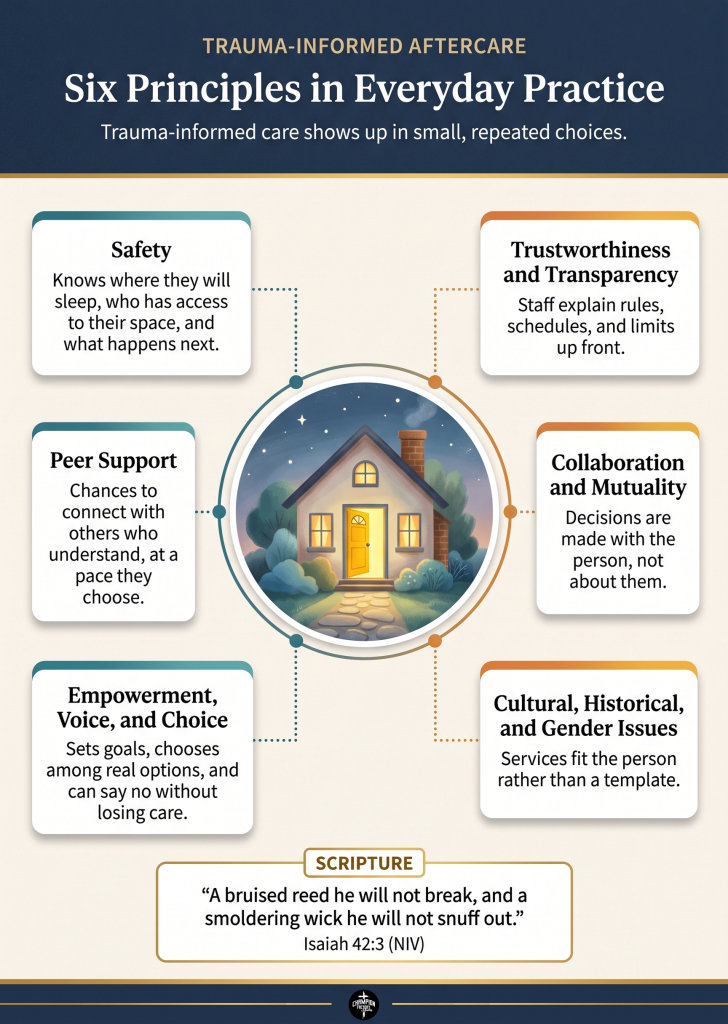
SAMHSA names six principles of a trauma-informed approach. They become real only when they shape ordinary moments.
Elizabeth Hopper, PhD, codirector of the National Center on Child Trafficking at Georgia State University, described the provider's role this way in the APA Monitor on Psychology: "our role as providers for this population is really around recognizing and elevating." Good aftercare builds on a survivor's strengths. It does not treat the person as a problem to fix.
Six Principles in Everyday Practice
- Safety: A survivor knows where they will sleep, who has access to their space, and what happens next.
- Trustworthiness and transparency: Staff explain rules, schedules, and limits up front, including what they can and cannot keep private.
- Peer support: Survivors have chances to connect with others who understand, at a pace they choose.
- Collaboration and mutuality: Staff, volunteers, and survivors work as partners. Decisions are made with the person, not about them.
- Empowerment, voice, and choice: The survivor sets goals, chooses among real options, and can say no without losing care.
- Cultural, historical, and gender issues: Care respects a person's language, culture, and background, and services fit the person rather than a template.
For a closer look at how these principles can shape an ordinary week, read Inside a Week of CFM's Rescue and Recovery Program.
Healing Does Not Require Retelling the Story
Some people assume survivors must tell their story to heal or to prove they need help. Trauma-informed programs work to avoid that. One clinic described in Public Health Reports used special intake procedures and a shared clinical record so survivors did not have to retell their history to every provider.
The lesson for you as a supporter is simple. Do not ask a survivor what happened. If they choose to share, listen calmly and without judgment. If they do not, their care and your kindness stay exactly the same.
How Long Does Trauma-Informed Aftercare Last?
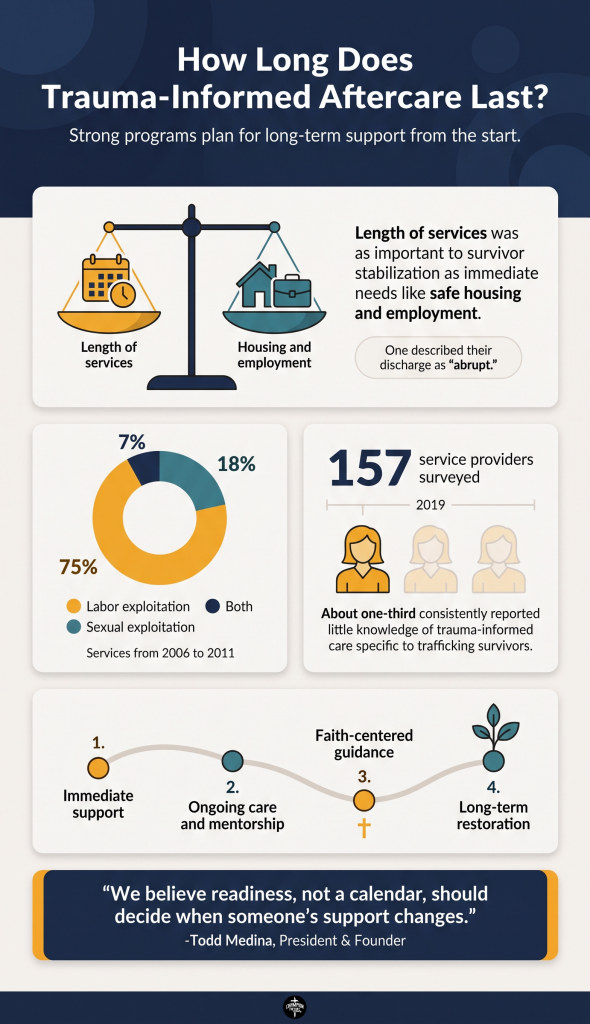
Psalm 147:3 (NIV) says, "He heals the brokenhearted and binds up their wounds." Binding wounds is slow, attentive work, and aftercare moves at a similar pace. Research shows that how long care lasts matters as much as meeting immediate needs like safe housing and employment. Strong programs plan for long-term support from the start and shape each plan around the person, not a fixed calendar.
The psalm places that healing inside God's work of rebuilding Jerusalem and gathering exiles home (Psalm 147:2). It describes who God is. It does not promise a set timeline for any person, and neither can any program.
An evaluation funded by the National Institute of Justice found that the length of services was as important to survivor stabilization as immediate needs like safe housing and employment. Some clients left programs because services were time-limited, not because they were ready. One described their discharge as "abrupt." Programs better able to identify and meet each person's individual needs saw greater stabilization. The study focused on foreign-born adult survivors in the United States.
A 2008 federal issue brief from HHS adds to the picture. It noted that many providers could not maintain the long-term treatment many victims require.
"We believe readiness, not a calendar, should decide when someone's support changes. That kind of patience costs more, and it is worth it." Todd Medina, President & Founder
How This Looks in the Ministry's Own Work
The Rescue and Recovery program "supports individuals who have experienced trafficking, exploitation, or unsafe living situations." Care "may include assistance with immediate needs, safe transitions, mentorship, encouragement, and faith-centered guidance as individuals begin the process of rebuilding their lives." The program's FAQ notes that support may continue as individuals work toward stability, healing, and renewed confidence.
The Our Approach page describes four stages of support: immediate support, ongoing care and mentorship, faith-centered guidance, and long-term restoration. It states, "We do not focus on one need alone," and, "Our focus is on consistent support."
Trauma-informed care shapes how the ministry tells stories, too. In a Rescue and Recovery impact story about a family supported through a crisis, the ministry wrote, "Names, locations, and specific details have been withheld from this account. That is a deliberate choice." The account describes helping to stabilize the family's circumstances, connecting them with protective support, and providing practical aid at key moments. Today the family lives in a safe, protected environment with ongoing support.
What Patient Care Asks of You
Long-term care changes what faithful support looks like.
- Choose steady, ongoing involvement over occasional one-time efforts when you can.
- Ask how a program decides when someone is ready to move on.
- Treat small steps, such as keeping an appointment or naming a personal goal, as real progress.
Where Does Faith Fit in Trauma-Informed Aftercare?
Faith fits in trauma-informed aftercare as an invitation, never a requirement. A survivor should receive the same food, shelter, and care whether or not they pray, attend a service, or share a program's beliefs. Spiritual encouragement is offered gently, when it is welcome, by people who have first shown they are safe. This respects the survivor's choice and reflects how Scripture describes God's care.
Trauma affects more than the body and mind. SAMHSA reports that trauma survivors have highlighted how traumatic events affect their spiritual beliefs and their ability to make meaning of what happened. Spiritual care belongs in whole-person aftercare, and it calls for great care in how it is offered.
A University of Memphis study based on interviews with eight survivor-advocates found mixed reactions to faith in aftercare. The same survivor-advocates described healthy aftercare environments as safe, empowering, collaborative, and non-transactional. The sample is small. It still gives faith communities an honest reason to slow down. When faith is tied to receiving help, it can feel like the same control a survivor has already escaped.
The wider field has reached a similar conclusion about conditions. Research on trauma-informed housing notes that some survivor housing programs require participation in case management or therapy, and even opening savings accounts, as conditions of using their services. It presents a voluntary services model as a way to make housing more trauma-informed and person-centered. We apply the same thinking to faith. The Rescue and Recovery program is rooted in faith and offers spiritual encouragement alongside practical support, never in place of it.
"Care here never depends on what someone believes. Our first job is to be safe people. If faith is welcomed, we share it the way Paul did, through steady lives, and we let each person decide what to receive." Todd Medina, President & Founder
What Scripture Shows About Gentle Care
Isaiah 42:3 (NIV) describes the Lord's servant: "A bruised reed he will not break, and a smoldering wick he will not snuff out." The verse belongs to the first Servant Song (Isaiah 42:1-4), which Matthew 12 later applies to Jesus. It shows a justice that is quiet and gentle toward the weak. It describes God's character. It is not a label for any person.
Paul described sharing faith in a similar way. In 1 Thessalonians 2:8 (NIV) he wrote, "Because we loved you so much, we were delighted to share with you not only the gospel of God but our lives as well." The verses before it stress that Paul's team used no trickery, flattery, or pressure. Faith shared through an honest life, with no pressure attached, is the model we follow.
Letting Faith Be Received, Not Required
- Offer prayer. Never assume it is wanted.
- Keep chapel time, Bible study, and discipleship optional and separate from meals, housing, and services.
- Let survivors lead spiritual conversations and set the pace.
- Point those who want to grow in faith toward Nourish Discipleship and Spiritual Growth when they are ready.
- Trust that God is at work even when a person is not ready to talk about Him.
How Can Churches and Volunteers Help Without Causing Harm?
Start by learning before you serve. Ask the aftercare program what training it offers, what volunteers should and should not say, and how to respond if a survivor shares something difficult. Then show up consistently in the role you are given. Reliable, low-pressure presence often matters more than any single act of help, and it protects survivors from well-meaning mistakes.
SAMHSA states that people can be re-traumatized by the very people whose intent is to help them. Shame adds another layer. HHS reports that survivors see shame as one of the greatest barriers to seeking mental health services. A curious question or a pitying look can deepen that shame without anyone meaning to.
In the same APA article, clinical psychologist Abigail Judge urged providers to avoid saviorism and lead with humility. That counsel fits churches too. Survivors are not projects or proof of a church's compassion. They are people with their own knowledge, goals, and choices.
You still have a real role. SAMHSA's guidance quotes one expert who put it simply: "one does not have to be a therapist to be therapeutic." Consistency, respect, and calm presence are things any trained volunteer can offer.
Luke 10:34 (NIV) describes the Samaritan's care: "He went to him and bandaged his wounds, pouring on oil and wine. Then he put the man on his own donkey, brought him to an inn and took care of him." In the next verse he pays the innkeeper, asks him to "Look after him," and promises to return. Care continued through a trusted partner, with a commitment to come back.
Practical Ways Your Church Can Help
- Learn the basics of trauma-informed care as a team before anyone serves.
- Meet practical needs the program names, such as transportation, meals, or household items.
- Serve as a consistent mentor through a structured program like Mentorship and Spiritual Guidance. The APA article notes that warm handoffs from trusted mentors can help build safety.
- Protect privacy. Never share photos, names, or stories without explicit permission from the person and the program.
- Pray faithfully, and keep those prayers private unless a survivor invites you in.
Here is a hypothetical example. A volunteer notices a survivor sitting alone at a shared meal. Instead of asking about the past, the volunteer asks whether the person would like company or would prefer quiet, and respects the answer. That small choice offers both safety and voice.
When to Step Back and Bring in Professionals
Volunteers are not counselors, case managers, or emergency responders. If a survivor describes current danger, thoughts of self-harm, or a medical need, connect them with program staff right away and follow the program's safety plan. If someone is in immediate danger, call 911. For guidance about a possible trafficking situation, contact the National Human Trafficking Hotline at 1-888-373-7888 or text 233733.
Licensed trauma-specific therapy belongs with trained professionals, and a good program helps survivors reach it. The ministry's field principle, shared in an outreach impact story, is to "help where help is possible, connect people to resources that can do more, and know when extended involvement would not produce the outcome everyone hopes for."
How Can You Tell If an Aftercare Program Is Truly Trauma-Informed?
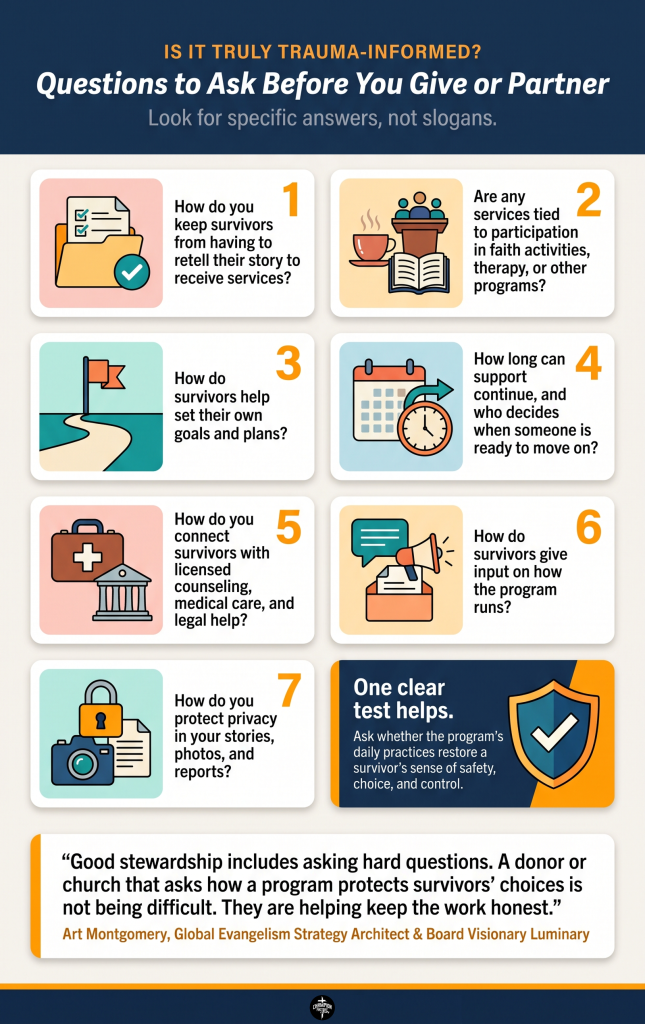
You may want to support aftercare but feel unsure how to judge a program from the outside. One clear test helps. Ask whether the program's daily practices restore a survivor's sense of safety, choice, and control. Look for specific answers, not slogans. A program that can explain how it handles intake, rules, privacy, faith activities, and length of care is more likely to practice what it claims.
That test comes from the Office for Victims of Crime Model Standards. They define trauma-informed approaches as placing priority on restoring the survivor's feelings of safety, choice, and control. They describe victim-centered work as nonjudgmental help that emphasizes self-determination. They describe survivor-informed programs as ones designed, implemented, and evaluated with intentional leadership and input from survivors.
"Good stewardship includes asking hard questions. A donor or church that asks how a program protects survivors' choices is not being difficult. They are helping keep the work honest." Art Montgomery, Global Evangelism Strategy Architect & Board Visionary Luminary
Questions to Ask Before You Give or Partner
- How do you keep survivors from having to retell their story to receive services?
- Are any services tied to participation in faith activities, therapy, or other programs?
- How do survivors help set their own goals and plans?
- How long can support continue, and who decides when someone is ready to move on?
- How do you connect survivors with licensed counseling, medical care, and legal help?
- How do survivors give input on how the program runs?
- How do you protect privacy in your stories, photos, and reports?
Signs That Call for More Questions
- Stories that include graphic details or information that could identify someone
- Language that presents survivors as rescued objects instead of people with choices
- Fixed timelines that end support on the same date for everyone
- Faith participation tied to food, housing, or services
- Fundraising built on urgency, fear, or guilt
None of these signs proves a program is unsafe. Each one is a reason to ask more questions before you give or partner.
Patient Care, Freely Given: Your Next Step in Supporting Survivors
Trauma-informed aftercare is safety, choice, and dignity restored through steady care over time. It works alongside licensed professionals and partner organizations. It keeps faith as an invitation, offered with the gentleness Scripture describes.
Your next step can be small and faithful:
- Pray for survivors and for the people who stay with them over the long term.
- Bring the questions above to any program you support.
- Learn more about the Rescue and Recovery program and how it fits within the ministry's whole-person approach.
If you would like to serve, explore ways to get involved, invite your church or organization to partner with Champion Factory Ministry, or give toward ongoing care. You can also view current causes to see other ways the ministry serves families.
FAQ
How long does aftercare for trafficking survivors last?
There is no standard length. It depends on each person's needs, safety, and goals. Survivor research has identified trust-building at the start and the end of aftercare as high-risk phases, so a gradual, planned transition matters as much as a strong beginning.
Do faith-based aftercare programs require survivors to take part in religious activities?
They should not. In trauma-informed, faith-based care, survivors receive the same support whether or not they take part in faith activities. If you are evaluating a program, ask how it explains optional faith activities to someone who has just arrived.
Is aftercare different for survivors of labor trafficking?
Care should fit the person and the type of exploitation they experienced. In the NIJ-funded evaluation of services for foreign-born adult survivors in the United States, 75 percent of women receiving services had experienced labor exploitation, 18 percent sexual exploitation, and 7 percent both. Aftercare cannot assume one kind of survivor.
What if someone is not ready to accept help?
Respect their choice and stay available. As one of the ministry's impact stories puts it, "willingness cannot be forced." When someone returns to an unsafe situation, it can be because a trafficker deliberately built an emotional attachment through cycles of harm and kindness, or because basic needs went unmet. That is not a personal failure.
Who should I contact if I think someone is being trafficked?
Call 911 if someone is in immediate danger. The National Human Trafficking Hotline is available 24 hours a day in English, Spanish, and more than 200 other languages. If a minor may be involved, contact local authorities or the hotline rather than stepping in on your own.
Scripture quotations taken from The Holy Bible, New International Version® NIV® Copyright © 1973, 1978, 1984, 2011 by Biblica, Inc.™ Used by permission. All rights reserved worldwide.